
CORSAIR
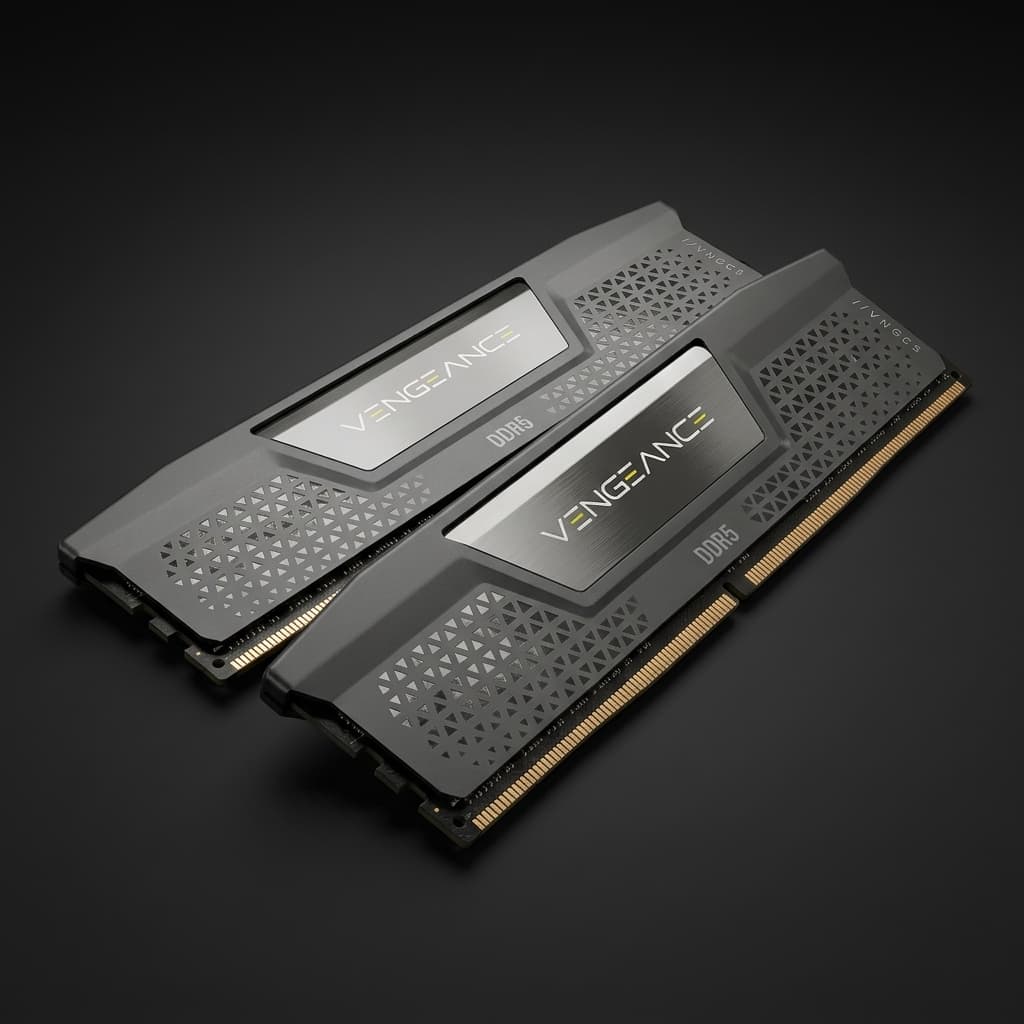
CORSAIR Vengeance DDR5 32GB (2 x 16GB) Up to 6000MHz AMD Intel RAM
A 32GB (2 x 16GB) DDR5-6000 CL30 desktop memory kit (CMK32GX5M2B6000Z30) rated at 1.40V, with AMD EXPO and Intel XMP 3.0 profiles for AM5 Ryzen and Intel DDR5 builds. Non-RGB aluminum heat spreader, overclock PMIC and a limited lifetime warranty.
CORSAIR Vengeance DDR5 32GB 6000MHz Review: Introduction
If you're building an AM5 Ryzen or Intel DDR5 PC, a 32GB DDR5-6000 CL30 kit is one of the most sensible memory choices you can make. The CORSAIR Vengeance DDR5 32GB (2 x 16GB) (model CMK32GX5M2B6000Z30) fits that brief. You get two 16GB modules rated at 6000 MT/s with CAS latency 30 at 1.40V, AMD EXPO and Intel XMP 3.0 profiles, an aluminum heat spreader and no RGB lighting.
Is it worth buying? For most gamers, streamers and everyday creators building on a DDR5 platform, yes. CL30 at 6000 MT/s is about as tight as mainstream DDR5 kits get, and the non-RGB design keeps things simple. The main caveats are that you need a DDR5 motherboard and that the rated speed is an overclock profile you enable in the BIOS. Whether it runs stably depends on your CPU, motherboard and BIOS.
Quick Verdict
- What it offers: 32GB (2 x 16GB) of DDR5-6000 CL30 desktop memory with EXPO and XMP 3.0 profiles in a plain, non-RGB aluminum design.
- Key specs: 6000 MT/s, CL30, 1.40V tested; 4800 MT/s CL40 at 1.1V default SPD; overclock PMIC; limited lifetime warranty.
- Who it's for: AM5 Ryzen 7000/9000 and Intel DDR5 builders who want low-latency 32GB without lighting software.
- Know before you buy: It only works on DDR5 motherboards. It runs at 4800 MT/s until you enable EXPO or XMP, and 6000 MT/s stability isn't guaranteed on every CPU and board.
CORSAIR Vengeance DDR5 Specifications
| Specification | Details |
|---|---|
| Brand | CORSAIR |
| Product | Vengeance DDR5 32GB (2 x 16GB) DDR5-6000 CL30 |
| Model number | CMK32GX5M2B6000Z30 |
| Capacity / kit | 32GB (2 x 16GB) |
| Memory generation | DDR5 |
| Rated data rate | 6000 MT/s (PC5-48000) |
| CAS latency | CL30 |
| Tested timings | 30-36-36-76 (retailer-listed; CORSAIR's spec table states CL30 only) |
| Tested voltage | 1.40V |
| SPD speed / latency | 4800 MT/s / CL40 |
| SPD voltage | 1.1V |
| AMD EXPO | Yes |
| Intel XMP | Yes, XMP 3.0 |
| PMIC | Overclock PMIC |
| Form factor / pins | Desktop UDIMM, 288-pin |
| Heat spreader | Aluminum |
| Lighting | None (non-RGB) |
| Color | Grey (per CORSAIR's spec table) |
| Module height | Not listed by CORSAIR |
| Chipsets (CORSAIR) | AMD 600 and 800 Series; Intel 600, 700 and 800 Series |
| Warranty | Limited lifetime (regional terms apply) |
Tested values apply once you enable the EXPO or XMP profile. SPD values are the JEDEC defaults the kit boots at without a profile. CORSAIR's own pages label this SKU inconsistently: the spec table says grey, but one page title says black. Check the photos and part number on the listing if color matters for your build.
Design and Build Quality
This is the standard Vengeance DDR5 design: a slim aluminum heat spreader with a clean, angular profile and no light bar. That means no RGB software, no extra lighting controllers and nothing to sync. It suits workstation-style builds, windowless cases and any build where the RAM shouldn't draw attention. The grey finish works in black, silver and neutral color schemes.
CORSAIR doesn't publish a module height for this SKU, and we couldn't confirm one from an official source. The non-RGB Vengeance design is compact, but don't assume it's low-profile. Check the RAM clearance spec of your CPU cooler, especially with large dual-tower air coolers such as the Noctua NH-D15 chromax.black, where the front fan can sit over the DIMM slots. AIO liquid coolers such as the ARCTIC Liquid Freezer III Pro 360 A-RGB avoid the issue entirely.
Performance: What DDR5-6000 CL30 Actually Means
6000MHz vs 6000 MT/s
"6000MHz" is the marketing label. The accurate unit is 6000 MT/s (megatransfers per second): DDR memory moves data twice per clock, so the real clock is 3000MHz. PC5-48000 describes peak bandwidth per module, which is 6000 MT/s × 8 bytes ≈ 48 GB/s. In dual-channel, that's a theoretical peak of about 96 GB/s.
Bandwidth and latency
Bandwidth is how much data the memory can move. Latency is how long the CPU waits for the first piece of data. True CAS latency in nanoseconds is roughly CL × 2000 ÷ MT/s:
- DDR5-6000 CL30 ≈ 10.0ns (this kit)
- DDR5-6000 CL36 ≈ 12.0ns
- DDR5-8000 CL38 ≈ 9.5ns
That makes CL30 one of the tightest common timings at 6000 MT/s. Secondary timings (tRCD, tRP) also matter, and the retailer-listed 36-36 here is competitive for the class.
What it means in practice
Memory speed matters most when the CPU is the bottleneck. That's typical of high-refresh 1080p gaming, simulation and strategy games, code compiling, and some creative tasks. At 1440p and 4K, the graphics card usually limits frame rate, and memory differences shrink. CPUs with large caches, such as the Ryzen 7 9800X3D, also tend to be less sensitive to memory tuning. Treat CL30 as a sensible optimization, not a dramatic upgrade over a good CL36 kit. Results vary with your CPU, motherboard, BIOS and workload.
AMD EXPO and Intel XMP 3.0 Compatibility
EXPO (AMD) and XMP (Intel) are profiles stored on the modules that tell the motherboard which speed, timings and voltage to apply. CORSAIR lists this SKU with both AMD EXPO and Intel XMP 3.0, so the kit isn't locked to one CPU brand. Both are overclocking profiles, though, and neither is a guarantee: CORSAIR notes that maximum performance depends on the motherboard and CPU.
AMD Ryzen (AM5)
CORSAIR lists AMD 600 and 800 Series chipsets, which means AM5 boards such as B650, X670, B850 and X870. That covers Ryzen 7000 and 9000 processors such as the Ryzen 5 7600X, Ryzen 5 9600X and Ryzen 9 9900X. DDR5-6000 is widely regarded as the practical sweet spot for AM5, because most CPUs can run the memory controller 1:1 with the memory clock at that speed. That still depends on the individual chip. Update to a current BIOS before enabling EXPO; newer AGESA releases often improve memory training. This kit won't work in AM4 boards such as the ASUS ROG Strix B550-F Gaming WiFi II, which are DDR4-only. Our AMD Ryzen motherboard compatibility guide explains the platforms.
Intel
CORSAIR lists Intel 600, 700 and 800 Series chipsets, covering 12th–14th Gen Core on DDR5 LGA1700 boards (for example the Core i9-14900K) and Core Ultra 200S on LGA1851. Many 600 and 700 Series boards were sold in separate DDR4 and DDR5 versions, so a Z790 or B760 name alone doesn't mean DDR5. Check the exact model. See AM5 vs LGA1700 explained for the bigger picture.
For either platform, check your motherboard's memory QVL (qualified vendor list) for CMK32GX5M2B6000Z30 or a close match. A kit that isn't on the QVL may still work, but QVL listing is the strongest compatibility signal available.
Gaming Performance
32GB has become the comfortable standard for gaming PCs. It gives headroom over 16GB for large open-world games, mods, and the browser tabs, Discord, launchers and overlays most people leave running. Gaming while streaming with OBS or recording gameplay is also more comfortable with 32GB than with 16GB. Faster, lower-latency memory can help minimum frame rates and smoothness in CPU-limited games. Your CPU, graphics card, resolution and settings still decide most of your frame rate. Our gaming PC build guide covers how the parts fit together.
Productivity and Content Creation
32GB comfortably handles everyday productivity, heavy multitasking, software development with an IDE, containers and browsers open, photo editing, and most 1080p and 1440p video editing. Bandwidth-sensitive work such as compiling, compression and some rendering can benefit from DDR5-6000. Requirements vary a lot, though. Long 4K/8K timelines, large After Effects projects, multiple virtual machines, big datasets or local AI models can exceed 32GB. If that describes your work, a 64GB (2 x 32GB) kit is the better buy.
Installation and Setup
- Confirm DDR5 support. Check that your motherboard has DDR5 DIMM slots. DDR4 and DDR5 are physically keyed differently and aren't interchangeable.
- Check the manual. Find the recommended slots for two modules, usually A2 and B2 (the second and fourth slots from the CPU).
- Install both modules. Push each one in evenly until the latches click. Two matched modules run in dual-channel mode.
- Update the BIOS if needed. This is especially important on early AM5 and LGA1700 boards.
- Enter the BIOS/UEFI. This is usually the Delete or F2 key at boot.
- Enable the profile. Choose EXPO on AMD or XMP on Intel. Menu names vary by board, for example "AI Overclock Tuner" on ASUS boards.
- Save and reboot. First boot may take longer while memory training runs, which is normal on AM5.
- Verify. Check the speed in the BIOS or with a tool such as CPU-Z: it should read about 3000MHz, which equals 6000 MT/s.
- Test stability. Run a memory stress test before relying on the system for important work.
If the system won't boot or is unstable with the profile enabled, update the BIOS, clear CMOS and try again, or step down to a lower speed such as 5600 MT/s. Enabling a memory profile is a form of overclocking, and some CPU and board combinations need troubleshooting.
Pros and Cons
Pros
- CL30 at 6000 MT/s (about 10ns) is among the tightest mainstream DDR5-6000 timings.
- Both AMD EXPO and Intel XMP 3.0 on one SKU.
- 6000 MT/s matches the widely recommended target for AM5 Ryzen.
- Matched 2 x 16GB kit for dual-channel operation.
- Non-RGB design: no lighting software, and it fits understated builds.
- Aluminum heat spreader and overclock PMIC.
- Limited lifetime warranty.
Cons
- DDR5 only: incompatible with AM4 and DDR4 Intel motherboards.
- Boots at 4800 MT/s CL40 until you enable EXPO or XMP.
- 1.40V is slightly higher than the 1.35V many rival kits use.
- 6000 MT/s stability depends on the CPU, motherboard and BIOS.
- No official module height, so check cooler clearance yourself.
- No RGB, if you want lighting.
- 32GB may be too little for heavy professional workloads.
CORSAIR Vengeance DDR5 vs Competitors
| RAM Kit | Capacity | Speed | CAS | Profiles | RGB | Main Difference | Best For |
|---|---|---|---|---|---|---|---|
| CORSAIR Vengeance DDR5 32GB (2 x 16GB) (CMK32GX5M2B6000Z30) | 2 x 16GB | 6000 MT/s | CL30 (30-36-36-76) | EXPO + XMP 3.0 | No | Tight timings, dual profile, 1.40V | AM5 or Intel builders wanting low latency without RGB |
| Kingston FURY Beast DDR5 32GB (KF560C30BBEK2-32) | 2 x 16GB | 6000 MT/s | CL30 (30-36-36) | AMD EXPO | No | Same primary timings, low-profile heat spreader | AMD builders wanting an EXPO-focused CL30 kit |
| Patriot Viper Venom DDR5 32GB (PVV532G600C30K) | 2 x 16GB | 6000 MT/s | CL30 (30-40-40-76) | EXPO + XMP 3.0 | No | Lower 1.35V, looser tRCD/tRP | Buyers wanting CL30 at 1.35V |
| TEAMGROUP T-Force Delta RGB DDR5 32GB (FF4D532G8000HC38DDC01) | 2 x 16GB | 8000 MT/s | CL38 (38-48-48-84) | XMP 3.0 | Yes | Much higher bandwidth, 1.45V, white RGB | Intel builders with boards that can run DDR5-8000 |
| Crucial Pro DDR5 32GB (CP2K16G60C36U5B) | 2 x 16GB | 6000 MT/s | CL36 (36-38-38-80) | EXPO + XMP 3.0 | No | Looser CAS, 1.35V, 5600 MT/s JEDEC default | Value-minded builders who prioritize simplicity |
Competitor specs come from the listed part numbers' manufacturer and retailer data. Brands sell close variants under different part numbers with different colors, profiles and timings, so confirm the part number on the listing before you buy.
vs Kingston FURY Beast DDR5-6000 CL30
The Kingston FURY Beast DDR5 32GB is the closest match: the same 6000 MT/s CL30-36-36 primary timings at 1.40V, also non-RGB. This part number is Kingston's EXPO version, so it's aimed at Ryzen builds, while the CORSAIR SKU lists both EXPO and XMP 3.0. Choose on price, aesthetics and your board's QVL; on paper they're very close.
vs Patriot Viper Venom DDR5-6000 CL30
The Patriot Viper Venom DDR5 32GB matches CL30 and carries both EXPO and XMP 3.0. It runs at a lower 1.35V, but its tRCD/tRP of 40 are looser than CORSAIR's listed 36. The CORSAIR kit has the slightly tighter timing set; the Patriot appeals if you prefer lower voltage.
vs TEAMGROUP T-Force Delta RGB DDR5-8000 CL38
The TEAMGROUP T-Force Delta RGB DDR5 32GB is a different kind of kit. At 8000 MT/s it offers far more bandwidth, with RGB lighting and a white finish, but it needs 1.45V and is listed for Intel 600/700 Series boards with XMP 3.0 only. Reaching DDR5-8000 typically requires a strong CPU memory controller and a board rated for it. On AM5, 8000 MT/s is beyond the usual 1:1 sweet spot, so the CORSAIR kit is the more practical Ryzen choice. Intel enthusiasts with capable boards may prefer the TEAMGROUP kit.
vs Crucial Pro DDR5-6000 CL36
The Crucial Pro DDR5 32GB also offers EXPO and XMP 3.0 at 6000 MT/s, at a lower 1.35V and with a higher 5600 MT/s JEDEC default. That default is useful if you'd rather not enable a profile at all. Its CL36-38-38-80 timings are looser than CORSAIR's CL30, so the CORSAIR kit is the better pick for latency, while the Crucial kit suits buyers who value a conservative setup.
Who Should Buy This RAM?
- Gaming PC builders who want 32GB at the popular DDR5-6000 speed with tight CL30 timings.
- AM5 Ryzen builders pairing it with B650, X670, B850 or X870 boards such as the MSI MAG B650 Tomahawk WiFi or GIGABYTE B850 AORUS Elite WiFi7.
- Intel DDR5 builders on 600, 700 or 800 Series DDR5 boards who want an XMP 3.0 kit.
- Users upgrading from 16GB of DDR5 who want a fresh matched kit rather than mixing modules.
- Anyone who wants a dual-channel 2 x 16GB kit without RGB or lighting software.
If that fits your build, you can check current pricing for the CORSAIR Vengeance DDR5 32GB (2 x 16GB) on Amazon.
Who Should Avoid It?
- DDR4 motherboard owners: AM4 and DDR4 Intel boards can't use DDR5.
- Systems that can't run DDR5-6000: Some older boards, BIOS versions or CPUs may not hold the profile stably. Check the QVL first.
- Heavy professional workloads: If you need more than 32GB, choose a 2 x 32GB kit.
- RGB fans: This SKU has no lighting. Consider an RGB kit instead.
- Bandwidth-focused Intel enthusiasts: A higher-speed kit may suit a capable Intel board better.
Final Verdict
The CORSAIR Vengeance DDR5 32GB (2 x 16GB) is a well-specified kit for mainstream DDR5 builds. You get 32GB in a dual-channel pair, 6000 MT/s with CL30 timings at 1.40V, both EXPO and XMP 3.0, an overclock PMIC and a limited lifetime warranty, in a clean non-RGB package. Its limitations are the usual DDR5 caveats: it needs a DDR5 board, the rated speed is a profile you enable, and stability depends on your platform. The Kingston FURY Beast is a near-equal alternative, and Crucial and Patriot trade a little latency or bandwidth for lower voltage. For a Ryzen 7000/9000 or Intel DDR5 build where you want low latency without RGB, this kit is easy to recommend on its specifications.
Browse more memory in our RAM category or find a compatible board in motherboards.
Pros
- CL30 at 6000 MT/s (about 10ns true latency) is among the tightest mainstream DDR5-6000 timings.
- Both AMD EXPO and Intel XMP 3.0 profiles on one SKU.
- 6000 MT/s matches the widely recommended target speed for AM5 Ryzen.
- Matched 2 x 16GB kit for dual-channel operation.
- Non-RGB design needs no lighting software and suits understated builds.
- Aluminum heat spreader and overclock PMIC.
- Limited lifetime warranty.
Cons
- DDR5 only: incompatible with AM4 and DDR4 Intel motherboards.
- Boots at 4800 MT/s CL40 until you enable EXPO or XMP in the BIOS.
- 1.40V tested voltage is slightly higher than the 1.35V many rival kits use.
- 6000 MT/s stability depends on the CPU memory controller, motherboard and BIOS.
- CORSAIR doesn't list a module height, so you have to check cooler clearance yourself.
- No RGB lighting for buyers who want it.
- 32GB may be too little for heavy 4K/8K editing, virtual machines or large datasets.
Spec Sheet
Specifications
General
| Brand | CORSAIR |
|---|---|
| Series | Vengeance DDR5 |
| Model | CMK32GX5M2B6000Z30 |
| ASIN | B0CBRJ63RT |
Memory
| Capacity | 32GB |
|---|---|
| Kit Configuration | 2 x 16GB |
| Memory Type | DDR5 |
| Form Factor | Desktop UDIMM |
| Pin Count | 288-pin |
Performance
| Tested Speed | 6000 MT/s |
|---|---|
| Speed Rating | PC5-48000 (DDR5-6000) |
| SPD Speed | 4800 MT/s |
| Memory Profiles | AMD EXPO, Intel XMP 3.0 |
| Note | Tested speed requires enabling EXPO or XMP; maximum performance depends on the motherboard and CPU |
Timings
| CAS Latency | CL30 |
|---|---|
| Tested Timings | 30-36-36-76 (retailer-listed) |
| SPD Latency | CL40 |
Voltage
| Tested Voltage | 1.40V |
|---|---|
| SPD Voltage | 1.1V |
| PMIC | Overclock PMIC |
Physical Design
| Heat Spreader | Aluminum |
|---|---|
| Color | Grey |
| Lighting | None (non-RGB) |
| Module Height | Not listed by CORSAIR |
Compatibility
| Chipsets (CORSAIR) | AMD 600 Series, AMD 800 Series, Intel 600 Series, Intel 700 Series, Intel 800 Series |
|---|---|
| Requirement | DDR5 DIMM slots; not compatible with DDR4 motherboards |
| Note | Check the motherboard QVL and BIOS version; many Intel 600/700 boards exist in DDR4 and DDR5 versions |
Warranty
| Warranty | Limited lifetime (subject to CORSAIR regional terms) |
|---|
Frequently Asked Questions
Is CORSAIR Vengeance DDR5 32GB 6000MHz good for gaming?+
Is 32GB DDR5 enough for gaming in 2026?+
Does this CORSAIR RAM support AMD EXPO?+
Does it support Intel XMP?+
Is DDR5-6000 compatible with Ryzen processors?+
Does this RAM work with Intel motherboards?+
Is CL30 good for DDR5 RAM?+
Can I use this RAM with a DDR4 motherboard?+
Do I need to enable EXPO or XMP manually?+
Can I mix this kit with another DDR5 memory kit?+
How is this different from CORSAIR's CL36 Vengeance kits?+
As an Amazon Associate we earn from qualifying purchases. See our affiliate disclosure.