
AMD
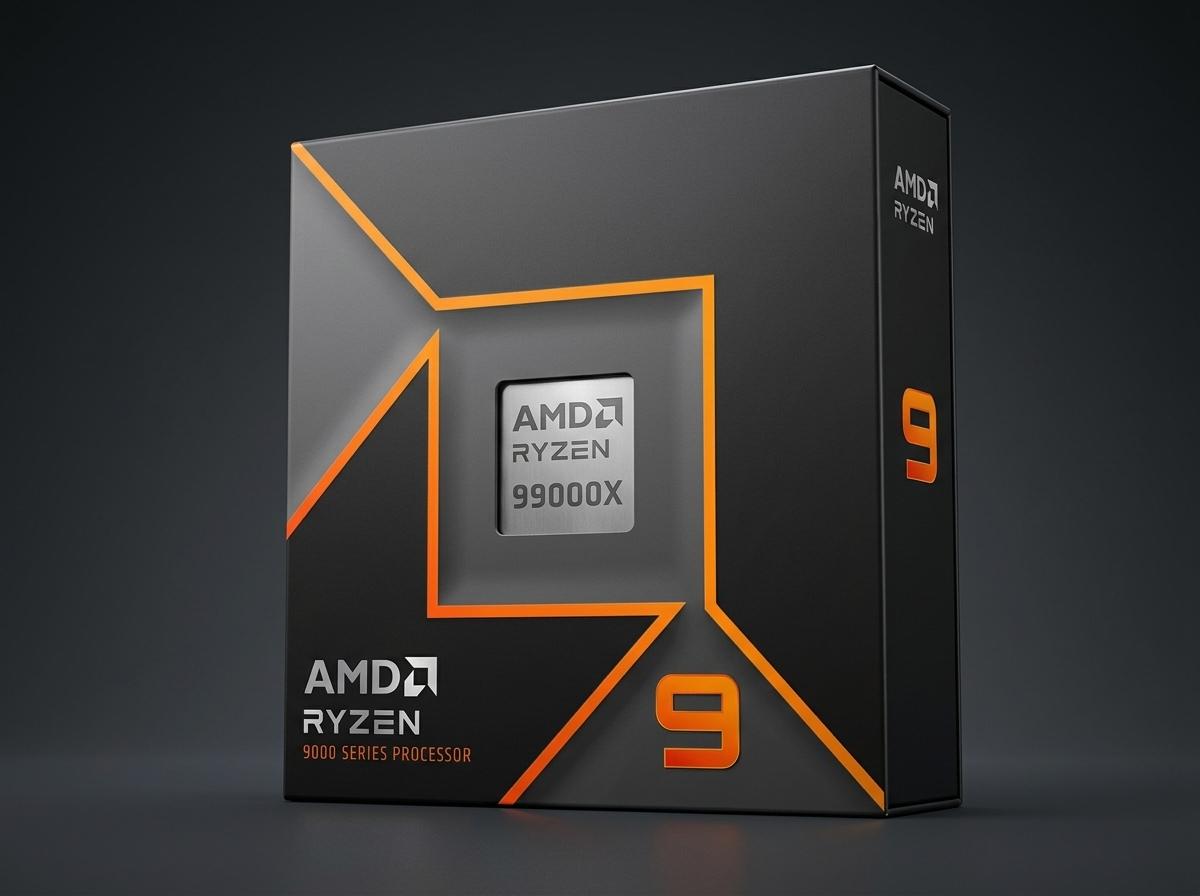
AMD Ryzen 9 9900X 12-Core, 24-Thread Unlocked Desktop Processor
AMD's 12-core, 24-thread Zen 5 desktop processor with up to 5.6 GHz boost and a 120W default TDP. An efficient all-rounder for creators, developers, streamers and gamers on the AM5 platform, with DDR5 and PCIe 5.0 support. Unlocked for tuning; cooler not included.
The AMD Ryzen 9 9900X is the 12-core, 24-thread member of AMD's Ryzen 9000 Series, sitting between the 8-core Ryzen 7 chips and the 16-core Ryzen 9 9950X. It uses AMD's Zen 5 architecture, boosts up to 5.6 GHz, and runs on the AM5 platform with DDR5 memory. In this AMD Ryzen 9 9900X review, we look at what those specs mean in practice: how it games, how it handles creative and development work, how much power it draws, and whether it's the right buy compared with AMD's X3D chips and Intel's alternatives.
The short version: the 9900X is an efficient, well-rounded productivity CPU that also games well. It's not the fastest gaming chip for the money, and buyers who mostly render or compile may get more from a 16-core part. Its best fit is someone who wants strong multi-threaded performance, modest power draw and a platform with an upgrade path.
How this review was written: We didn't test this processor ourselves. This is a research-based review that combines AMD's official specifications with independent benchmark data from established reviewers, cited next to each claim. Real-world performance depends on the game or application, GPU, resolution, cooling, memory, BIOS, motherboard and power settings.
Quick Verdict
- Overall: A capable, efficient 12-core all-rounder with strong productivity performance and good, though not class-leading, gaming performance.
- Best for: Creators, developers, streamers and multitaskers who also game, and who want an AM5 platform.
- Main strength: Strong multi-threaded and single-threaded performance at a 120W default TDP, with lower measured power than the 170W Ryzen 9 7900X.
- Main drawback: For gaming alone, the Ryzen 7 9800X3D is faster, and cheaper Zen 5 chips game about as well as the 9900X does.
- Value: Depends on street price. Reviewers at launch criticized its price. Later market pricing has been considerably lower, so compare current prices against the Ryzen 9 7900X and Intel Core i7-14700K.
- Platform: Requires an AM5 motherboard (with a BIOS that supports Ryzen 9000) and DDR5 memory. No cooler is included.
- Consider an alternative if: You only game (Ryzen 7 9800X3D), you need maximum multi-threaded throughput (Ryzen 9 9950X), or you want the lowest price for 12 cores (Ryzen 9 7900X).
Editorial score: 7.9/10. This is our editorial judgment, not an AMD rating. We weighted gaming performance (25%), productivity performance (25%), value at current street prices (20%), power efficiency and cooling (15%), and platform and upgrade path (15%). The 9900X scores well on efficiency, platform and productivity, and loses points on gaming value.
AMD Ryzen 9 9900X Specifications
All specifications below come from AMD's official Ryzen 9 9900X product page.
| Specification | AMD Ryzen 9 9900X |
|---|---|
| Full product name | AMD Ryzen 9 9900X (Ryzen 9000 Series, codename Granite Ridge) |
| Architecture | Zen 5 |
| Process | TSMC 4nm FinFET (CPU cores), TSMC 6nm FinFET (I/O die) |
| CPU cores / threads | 12 / 24 |
| Base clock | 4.4 GHz |
| Max boost clock | Up to 5.6 GHz |
| L1 cache | 960 KB |
| L2 cache | 12 MB |
| L3 cache | 64 MB |
| Total L2 + L3 cache | 76 MB |
| Default TDP | 120W |
| Max operating temperature (Tjmax) | 95°C |
| CPU socket | AM5 |
| Supported chipsets | X870E, X870, B850, B840, X670E, X670, B650E, B650, A620 |
| Memory type | DDR5, 2 channels, up to 256 GB, ECC supported (requires motherboard support) |
| Official memory speed | DDR5-5600 (2 DIMMs, 1R or 2R); DDR5-3600 (4 DIMMs) |
| PCI Express | PCIe 5.0, 28 total / 24 usable CPU lanes |
| Integrated graphics | AMD Radeon Graphics, 2 graphics cores, 2,200 MHz |
| Overclocking | Unlocked; supports Precision Boost Overdrive, Curve Optimizer and AMD EXPO memory overclocking |
| Instruction extensions | Includes AVX-512 |
| Cooler included | No (AMD recommends a liquid cooler for optimal performance) |
| Launch date | August 15, 2024 |
A note on cache: AMD's "76 MB" figure is L2 (12 MB) plus L3 (64 MB). The 960 KB of L1 is listed separately and isn't included in that total. Don't confuse the 9900X with the Ryzen 9 9900X3D, a different product with the same core count but extra stacked L3 cache.
Zen 5 Architecture and Features
What Zen 5 brings
Zen 5 is AMD's 2024 desktop core design. It improves instructions per clock (how much work each core does per cycle) rather than simply raising clock speeds. The 9900X has the same 5.6 GHz boost as the older Ryzen 9 7900X, so its gains come mostly from the architecture. One notable change is a full 512-bit data path for AVX-512 instructions, which helps in some scientific, AI and professional workloads but matters little in most consumer applications (TechPowerUp).
12 cores across two chiplets
The 9900X uses two CPU chiplets with six active cores each, plus a separate I/O die. Every core is a full Zen 5 core with simultaneous multithreading, so there are no "efficiency cores" for the scheduler to manage. With two chiplets, games run best when their threads stay on one chiplet. AMD advised reviewers that Windows Game Mode, an up-to-date Xbox Game Bar, the Balanced power plan and AMD's chipset driver should be in place for optimal game thread placement, as TechPowerUp reported. Keep Windows and the AMD chipset driver up to date.
Cache and boost behavior
The 64 MB of L3 cache is split between the two chiplets, 32 MB each. That's plenty for most work, but it's far less than the 96 MB or more that AMD's X3D chips put on a single chiplet, which is why X3D chips are faster in many games. The 5.6 GHz boost is a maximum, not a sustained all-core clock. Precision Boost 2 adjusts clocks based on temperature, power and current headroom, so cooling and motherboard settings affect real-world speed.
Tuning and platform features
The chip is unlocked and supports Precision Boost Overdrive, Curve Optimizer and AMD EXPO memory profiles. AM5 provides PCIe 5.0 and DDR5. Features such as USB4, Wi-Fi 7 and the number of M.2 slots depend on the motherboard. The built-in Radeon graphics (2 cores) is meant for display output, troubleshooting and light media use, not serious gaming.
Ryzen 9 9900X Gaming Performance
CPU gaming tests are usually run at 1080p with a top graphics card so the processor, rather than the GPU, sets the frame rate. The clearest single comparison comes from TechPowerUp's Ryzen 7 9800X3D review (November 2024), which tested every CPU here on the same RTX 4090 system. Scores are relative to the Ryzen 7 9800X3D (100%):
| CPU | 1080p | 1440p | 4K |
|---|---|---|---|
| Ryzen 7 9800X3D | 100% | 100% | 100% |
| Core i9-14900K | 92.8% | 95.9% | 98.9% |
| Core i7-14700K | 91.0% | 94.9% | 98.5% |
| Ryzen 9 9950X | 89.2% | 92.4% | 98.0% |
| Ryzen 9 9900X | 88.2% | 92.2% | 98.0% |
| Ryzen 9 7900X | 86.9% | 92.1% | 97.9% |
Source: TechPowerUp, averaged across its game suite at Ultra settings. Other reviewers with different games and settings report different margins.
What the numbers mean:
- Vs. Ryzen 7 9800X3D: The 9800X3D was about 13% faster at 1080p in this test. The gap shrank to roughly 8% at 1440p and about 2% at 4K, where the GPU becomes the main limit. A higher-tier Ryzen 9 isn't automatically faster in games than a Ryzen 7 X3D.
- Vs. Ryzen 9 7900X: In its own 9900X launch review, TechPowerUp found the 9900X 2% faster at 1080p. In Gamers Nexus's review, gains ranged from none (Baldur's Gate 3) to a few percent in most titles.
- Vs. Intel: Intel's Raptor Lake chips were slightly ahead in TechPowerUp's gaming averages, by about 3% for the i7-14700K at 1080p.
- Vs. its siblings: TechPowerUp noted that all Zen 5 models land within a narrow 2% band in gaming. A cheaper 6- or 8-core Ryzen 9000 chip delivers nearly the same frame rates.
Bottom line for gamers: The 9900X delivers high frame rates and works well for high-refresh-rate and competitive play. But for a gaming-only build, its extra cores add cost without adding frames. The Ryzen 7 9800X3D is faster, and a cheaper Zen 5 chip games almost identically. The 9900X makes more sense when gaming shares the machine with streaming, editing or development work.
Productivity and Content Creation
This is where the 9900X's 12 cores pay off. In TechPowerUp's application summary from the same November 2024 test suite, relative to the 9800X3D at 100%, the 9900X scored 112.0%. That compares with 125.1% for the Ryzen 9 9950X, 119.5% for the Core i9-14900K, 110.2% for the Core i7-14700K and 107.1% for the Ryzen 9 7900X.
- 3D rendering: Gamers Nexus measured 7.7 minutes in its Blender render, versus 9 minutes for the 7900X and 7.9 minutes for the Core i9-14900K. The 16-core 9950X needed 23% less time than the 9900X.
- Software development: In Gamers Nexus's Chromium compile test, the 9900X took 80 minutes, tied with the Core i7-14700K and faster than the 7900X (87 minutes). The 9950X finished in 66 minutes.
- Adobe applications: In Puget benchmarks run by Gamers Nexus, the 9900X tied the 9950X in Photoshop and was roughly tied with the i7-14700K in Premiere Pro, where the 9950X led by about 5.5%.
- Compression: In 7-Zip, Gamers Nexus found the 14700K about 3% ahead in compression, while the 9900X led it by about 8% in decompression.
- Generational gain: Across 49 applications, TechPowerUp measured a 4.4% average uplift over the 7900X at launch. Larger gains appeared in AVX-512-heavy, rendering and AI workloads, and some tests showed no gain.
- Single-threaded work: Zen 5's per-core performance is strong. TechPowerUp highlighted record results in lightly threaded tasks such as MP3 encoding, which helps everyday responsiveness.
- Streaming and multitasking: With 24 threads, there's headroom to game while running a software encoder, browser and chat apps. Many streamers use their GPU's hardware encoder instead, which reduces CPU load further.
12 cores or 16? If your workload scales across every thread, such as long renders, large compiles or heavy encoding, the 9950X's four extra cores deliver a meaningful time saving. If you mix lighter creative work with gaming, the 9900X covers most needs for less money.
Power Consumption, Temperatures and Cooling
AMD rates the 9900X at a 120W default TDP, down from 170W on the Ryzen 9 7900X. TDP is a thermal design rating, not a measurement of how much power the chip uses in every workload. Actual draw varies by workload and motherboard settings.
- Measured draw: Gamers Nexus measured 176W at the CPU power cables in an all-core Blender render, compared with 199W for the 7900X. TechPowerUp measured a 113W average across 49 applications, compared with 123W for the 7900X.
- Efficiency: Gamers Nexus found the 9900X used about 24% less energy than the 7900X to finish its Blender job.
- Idle: TechPowerUp measured full-system idle power about 20W higher than a comparable Intel system, a trait shared with Zen 4.
- Temperatures: On a Noctua NH-D15 air cooler at stock settings, TechPowerUp recorded 71°C in Blender versus 92°C for the 7900X. Results will differ with your cooler, case and room temperature.
Cooling advice: The boxed 9900X does not include a cooler. AMD's official guidance is that a liquid cooler is recommended for optimal performance. Independent testing suggests a quality dual-tower air cooler handles it well at stock settings. If you plan to use Precision Boost Overdrive or overclock, power and heat climb quickly, and TechPowerUp reports hitting the 95°C limit even with water cooling. When the chip reaches its limit, it lowers clocks rather than shutting down, so better cooling mainly buys sustained performance and lower fan noise. Good case airflow matters for long multi-core workloads.
Motherboard, RAM and Compatibility
- Socket: AM5 only. The 9900X will not fit AM4 motherboards.
- Chipsets: X870E, X870, B850, B840, X670E, X670, B650E, B650 and A620, according to AMD. Older 600-series boards need a BIOS update that adds Ryzen 9000 support, so check the board's CPU support list. A board with BIOS Flashback makes updating possible without a compatible CPU installed.
- Memory: DDR5 only. AMD's official rating is DDR5-5600 with two DIMMs and DDR5-3600 with four. Faster EXPO kits (DDR5-6000 is common) usually work but are technically overclocking. TechPowerUp's review sample needed a small SoC voltage increase to run DDR5-6000 stably.
- PCIe 5.0: High-end boards typically provide PCIe 5.0 x16 for graphics and PCIe 5.0 x4 for an M.2 SSD. Exact lane allocation depends on the motherboard.
- Upgrading from AM4: You'll need a new motherboard and DDR5 memory, which adds significantly to the cost. Budget for the full platform, not just the CPU.
- Upgrade path: AMD has said it will support AM5 with future CPUs through at least 2027, as TechPowerUp reported, which gives AM5 builds a longer runway than Intel's LGA1700.
- First boot: Expect long memory training on the first boot after installation or a CMOS clear. TechPowerUp measured almost three minutes. Subsequent boots are fast.
Pros and Cons
Pros
- 12 Zen 5 cores / 24 threads with strong multi-threaded performance
- Excellent single-threaded performance
- 120W default TDP and lower measured power than the Ryzen 9 7900X
- Full-speed AVX-512 for supported professional workloads
- AM5 platform with PCIe 5.0 and a stated upgrade path
- Integrated graphics for display output and troubleshooting
Cons
- Slower in games than the Ryzen 7 9800X3D
- Small gains over the Ryzen 9 7900X
- The Ryzen 9 9950X is notably faster in heavily threaded work
- No bundled cooler
- Requires an AM5 motherboard and DDR5 memory
- Higher idle power than comparable Intel systems
Ryzen 9 9900X vs. Competitors: Comparison Table
AMD rates its chips by TDP, while Intel uses Processor Base Power and Maximum Turbo Power. The two systems are defined differently and shouldn't be compared directly. Prices change frequently, so check current pricing through each link.
| Processor | Cores / Threads | Architecture | Max Boost | Cache (L2 + L3) | Power Spec | Socket / Memory | Best Use | Price | Buy |
|---|---|---|---|---|---|---|---|---|---|
| AMD Ryzen 9 9900X | 12 / 24 | Zen 5 | 5.6 GHz | 12 MB + 64 MB | 120W TDP | AM5 / DDR5 | Efficient gaming + productivity all-rounder | Check current price | View Ryzen 9 9900X on Amazon |
| AMD Ryzen 9 9950X | 16 / 32 | Zen 5 | 5.7 GHz | 16 MB + 64 MB | 170W TDP | AM5 / DDR5 | Heavy rendering, compiling, encoding | Check current price | View Ryzen 9 9950X on Amazon |
| AMD Ryzen 9 7900X | 12 / 24 | Zen 4 | 5.6 GHz | 12 MB + 64 MB | 170W TDP | AM5 / DDR5 | Lower-cost 12-core option | Check current price | View Ryzen 9 7900X on Amazon |
| AMD Ryzen 7 9800X3D | 8 / 16 | Zen 5 with 3D V-Cache | 5.2 GHz | 8 MB + 96 MB | 120W TDP | AM5 / DDR5 | Gaming | Check current price | View Ryzen 7 9800X3D on Amazon |
| AMD Ryzen 9 9900X3D | 12 / 24 | Zen 5 with 3D V-Cache | 5.5 GHz | 12 MB + 128 MB | 120W TDP | AM5 / DDR5 | 12 cores plus extra gaming cache | Check current price | View Ryzen 9 9900X3D on Amazon |
| Intel Core i7-14700K | 20 (8P+12E) / 28 | Raptor Lake Refresh | 5.6 GHz | 28 MB + 33 MB | 125W base / 253W max turbo | LGA1700 / DDR4 or DDR5 | Value productivity + gaming | Check current price | View Core i7-14700K on Amazon |
Specifications from AMD, Intel and Tom's Hardware specification tables.
Key differences: The 9950X adds four cores for faster heavy workloads but has a higher 170W TDP. The 7900X offers the same core count on Zen 4 with slightly lower performance and higher power. The 9800X3D trades cores for gaming cache. The 9900X3D keeps 12 cores and adds 3D V-Cache, but TechSpot's early-2026 guide suggests most buyers at that price are better served by a 16-core model. The Core i7-14700K performs similarly in many applications and can be cheaper. However, it draws more power under heavy loads, its LGA1700 platform has no newer upgrade path, and it's subject to Intel's 13th/14th Gen microcode and BIOS guidance.
Which CPU Should You Buy?
- Gamers, and anyone prioritizing gaming over productivity: Choose the Ryzen 7 9800X3D. It's faster in games, and at higher resolutions the difference shrinks for every CPU anyway.
- Streamers: The 9900X is a good fit, especially with CPU-based encoding. If you encode on the GPU, a 9800X3D will still game faster.
- Video editors and content creators: The 9900X handles Premiere, Photoshop and rendering well. If exports and renders are daily work, the Ryzen 9 9950X saves meaningful time.
- Developers: The 9900X tied the i7-14700K in Gamers Nexus's Chromium compile test. Large codebases favor the 9950X's 16 cores. Smaller projects run well on the 9900X.
- Multitasking and productivity users: The 9900X is a strong, efficient choice that runs cooler and quieter than higher-power alternatives.
- Existing AM5 owners: It's a drop-in upgrade after a BIOS update. Upgrading from a Ryzen 9 7900X brings only modest gains, so it's better suited to owners of 6- or 8-core Ryzen 7000 chips.
- Upgrading from AM4: Budget for an AM5 motherboard and DDR5 RAM. The platform cost may make the CPU tier less important than getting a good board and memory.
- Building a complete new PC: The 9900X is a sensible all-round pick on a platform with a stated upgrade path. Compare it against the Core i7-14700K if the current price gap is large.
- Buyers who need more cores: Go straight to the Ryzen 9 9950X.
- Budget-focused 12-core buyers: The Ryzen 9 7900X delivers similar performance if it's noticeably cheaper, at the cost of higher power draw.
- Want 12 cores and stronger gaming? The Ryzen 9 9900X3D adds 3D V-Cache, but compare its price against the 9800X3D and 16-core models first.
Final Verdict
The AMD Ryzen 9 9900X is a well-balanced 12-core processor. Its strengths are strong multi-threaded and single-threaded performance, efficient 120W operation, AVX-512 capability and the AM5 platform. The trade-offs are clear: dedicated gamers get more from the Ryzen 7 9800X3D, heavy renderers get more from the Ryzen 9 9950X, and its lead over the Ryzen 9 7900X is small.
It's best for people who split their time between gaming and real work, such as streamers, editors, developers and heavy multitaskers, and who want a modern platform with room to upgrade. Buy it at a fair street price and pair it with a good cooler.
Check the latest price of the AMD Ryzen 9 9900X on Amazon
Frequently Asked Questions
Is the AMD Ryzen 9 9900X good for gaming?
Yes. It delivers high frame rates and suits high-refresh-rate play. However, it isn't the fastest gaming CPU for the money. In TechPowerUp's testing with an RTX 4090, the Ryzen 7 9800X3D was about 13% faster at 1080p, and cheaper Zen 5 chips game almost as well. The gap narrows at 1440p and nearly disappears at 4K.
How many cores and threads does the Ryzen 9 9900X have?
The Ryzen 9 9900X has 12 Zen 5 cores and 24 threads, split across two six-core chiplets. All are full-performance cores, with no separate efficiency cores. It has a 4.4 GHz base clock, a boost of up to 5.6 GHz, 12 MB of L2 cache and 64 MB of L3 cache.
Does the Ryzen 9 9900X include a cooler?
No. The boxed Ryzen 9 9900X doesn't include a CPU cooler. AMD recommends a liquid cooler for optimal performance. Independent testing shows a quality dual-tower air cooler handles it well at stock settings, but overclocking or PBO increases heat substantially.
What motherboard does the Ryzen 9 9900X require?
It requires an AM5 motherboard. AMD lists the X870E, X870, B850, B840, X670E, X670, B650E, B650 and A620 chipsets. Older 600-series boards may need a BIOS update for Ryzen 9000 support, so check the manufacturer's CPU support list. It doesn't work in AM4 motherboards.
Does the Ryzen 9 9900X support DDR5?
Yes, and only DDR5. It doesn't support DDR4. AMD officially rates it for DDR5-5600 with two memory modules and DDR5-3600 with four, and up to 256 GB total. Faster EXPO kits like DDR5-6000 usually work but count as memory overclocking and aren't guaranteed.
Is the Ryzen 9 9900X worth buying?
It can be, for buyers who need strong productivity performance plus good gaming on an efficient, upgradeable platform. Its value depends heavily on street price. Compare it with the Ryzen 9 7900X, the Ryzen 9 9950X and the Core i7-14700K before buying. Gaming-only buyers should look at the Ryzen 7 9800X3D.
Is the Ryzen 9 9900X better than the Ryzen 7 9800X3D for gaming?
No. The 9800X3D's large stacked L3 cache makes it faster in most games. TechPowerUp measured it about 13% ahead at 1080p. The 9900X is the better choice for multi-threaded work. TechPowerUp's application average put it roughly 12% ahead of the 9800X3D.
Should I buy the Ryzen 9 9900X or Ryzen 9 9950X?
Choose the 9950X if you regularly render, compile large projects or encode video. Its 16 cores cut Blender render time by about 23% in Gamers Nexus's test. Choose the 9900X if your work is lighter or mixed with gaming. It games about the same, uses less power and usually costs less.
Pros
- 12 Zen 5 cores / 24 threads with strong multi-threaded performance
- Excellent single-threaded performance
- 120W default TDP and lower measured power than the Ryzen 9 7900X
- Full-speed AVX-512 for supported workloads
- AM5 platform with PCIe 5.0 and a stated upgrade path
- Integrated graphics for display output and troubleshooting
Cons
- Slower in games than the Ryzen 7 9800X3D
- Small gains over the Ryzen 9 7900X
- Ryzen 9 9950X is notably faster in heavily threaded work
- No bundled cooler
- Requires an AM5 motherboard and DDR5 memory
- Higher idle power than comparable Intel systems
Spec Sheet
Specifications
General
| Brand | AMD |
|---|---|
| Model | Ryzen 9 9900X |
| Product family | Ryzen 9000 Series |
| Codename | Granite Ridge |
| Architecture | Zen 5 |
| Process | TSMC 4nm FinFET (CPU), TSMC 6nm FinFET (I/O die) |
| Launch date | August 15, 2024 |
| Boxed product ID | 100-100000662WOF |
| Unlocked | Yes |
Performance
| CPU cores | 12 |
|---|---|
| Threads | 24 |
| Base clock | 4.4 GHz |
| Max boost clock | Up to 5.6 GHz |
| Boost technology | Precision Boost 2 |
| Overclocking features | Precision Boost Overdrive, Curve Optimizer, AMD EXPO |
| Instruction extensions | Includes AVX-512 |
Cache
| L1 cache | 960 KB |
|---|---|
| L2 cache | 12 MB |
| L3 cache | 64 MB |
| Total L2 + L3 | 76 MB |
Memory
| Memory type | DDR5 |
|---|---|
| Memory channels | 2 |
| Max memory | 256 GB |
| Official speed (2 DIMMs) | DDR5-5600 |
| Official speed (4 DIMMs) | DDR5-3600 |
| ECC support | Yes (requires motherboard support) |
Connectivity
| PCIe version | PCIe 5.0 |
|---|---|
| CPU PCIe lanes (total / usable) | 28 / 24 |
| Native USB | 4x USB 3.2 Gen 2, 1x USB 2.0 |
Graphics
| Integrated graphics | AMD Radeon Graphics |
|---|---|
| Graphics cores | 2 |
| Graphics frequency | 2200 MHz |
Power and Cooling
| Default TDP | 120W |
|---|---|
| Max operating temperature | 95°C |
| Cooler included | No |
| Recommended cooler | Liquid cooler recommended for optimal performance (AMD) |
Compatibility
| Socket | AM5 |
|---|---|
| Supported chipsets | X870E, X870, B850, B840, X670E, X670, B650E, B650, A620 |
| OS support | Windows 11 64-bit, Windows 10 64-bit, RHEL x86 64-bit, Ubuntu x86 64-bit |
Frequently Asked Questions
Is the AMD Ryzen 9 9900X good for gaming?+
How many cores and threads does the Ryzen 9 9900X have?+
Does the Ryzen 9 9900X include a cooler?+
What motherboard does the Ryzen 9 9900X require?+
Does the Ryzen 9 9900X support DDR5?+
Is the Ryzen 9 9900X worth buying?+
Is the Ryzen 9 9900X better than the Ryzen 7 9800X3D for gaming?+
Should I buy the Ryzen 9 9900X or Ryzen 9 9950X?+
As an Amazon Associate we earn from qualifying purchases. See our affiliate disclosure.