
AMD
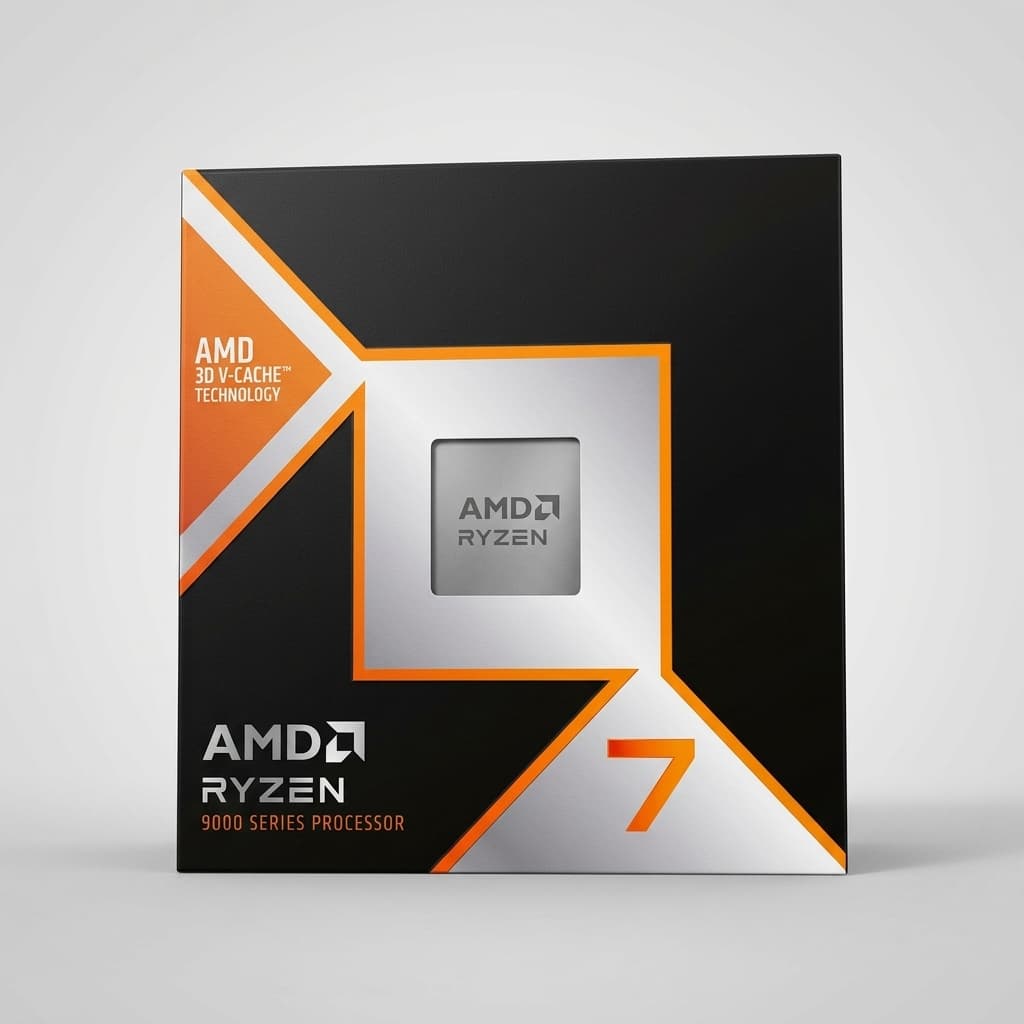
AMD Ryzen 7 9800X3D 8-Core, 16-Thread Desktop Processor
The Ryzen 7 9800X3D is AMD’s 8-core, 16-thread Zen 5 gaming processor with 96 MB of L3 cache from second-generation 3D V-Cache. It is built for players chasing high frame rates on AM5, and it is also much stronger in productivity work than earlier X3D chips.
The AMD Ryzen 7 9800X3D 8-Core, 16-Thread Desktop Processor is a gaming-first CPU. It pairs eight Zen 5 cores with 96 MB of L3 cache, and 64 MB of that comes from AMD's second-generation 3D V-Cache, a cache layer stacked onto the processor die. In this Ryzen 7 9800X3D review, we bring together AMD's official specifications and published independent benchmarks so you can decide whether it suits your build, your graphics card, and your budget.
Transparency note: We have not tested this processor ourselves. The specifications come from AMD. The performance figures come from named independent reviewers, and we attribute each one. The verdicts and recommendations on this page are our own editorial analysis.
Quick Verdict
If gaming is your main reason for upgrading and you own (or plan to buy) a high-end graphics card, the Ryzen 7 9800X3D is one of the strongest CPUs you can put in an AM5 motherboard. At launch, TechPowerUp and TechSpot both measured it as the fastest gaming processor they had tested. Unlike earlier X3D chips, it also improves substantially on productivity work. The drawbacks are a high price for an eight-core chip, much smaller gains at 1440p and 4K where the GPU limits frame rates, and multithreaded performance that trails similarly priced chips with more cores.
Key reasons to buy
- Top-tier gaming performance: it led the gaming charts in both major launch reviews we cite, especially in CPU-limited and cache-sensitive games.
- A real productivity upgrade over the 7800X3D: TechPowerUp measured application performance about 18% higher than the previous X3D model.
- Drops into existing AM5 boards: it is supported on A620, B650, B650E, X670, X670E, B840, B850, X870, and X870E motherboards, though a BIOS update may be required.
- Unlocked for overclocking: AMD lists support for manual overclocking, Precision Boost Overdrive, Curve Optimizer, and EXPO memory profiles.
- Simple core layout: all eight cores share a single die and a single core type, so there is no scheduling between performance and efficiency cores.
Best for / Not ideal for
- Best for: high-refresh-rate gamers at 1080p and 1440p, competitive esports players, and simulation, strategy, and racing fans whose games depend heavily on the CPU and its cache.
- Not ideal for: buyers focused on rendering, encoding, or compiling, budget builds where the money is better spent on the GPU, or 4K gamers on mid-range graphics cards.
What Makes the Ryzen 7 9800X3D Different
Second-generation 3D V-Cache
Games constantly fetch small pieces of data such as physics state, AI logic, and world information. When that data is already in the CPU's cache, the processor does not have to wait on slower system memory. The 9800X3D stacks an extra 64 MB of cache on top of the standard 32 MB, for 96 MB of L3 in total. Games whose working data fits in that larger cache tend to see the biggest gains.
For this generation, AMD placed the cache layer underneath the CPU cores instead of on top of them. That puts the hot cores closer to the cooler, so the chip can hold higher clock speeds. The result is a 4.7 GHz base clock and up to a 5.2 GHz boost clock, both noticeably higher than the Ryzen 7 7800X3D's.
Zen 5 cores on a single die
All eight cores sit on a single TSMC 4 nm compute die. This matters for gaming because a game's threads never have to communicate across two separate core clusters, which adds latency on AMD's 12- and 16-core models. The chip also supports the AVX-512 instruction set, which helps in some scientific, emulation, and AI workloads.
Fully unlocked
Earlier X3D processors limited overclocking. AMD lists the 9800X3D as unlocked, with support for Precision Boost Overdrive, Curve Optimizer, and Ryzen Master. In TechPowerUp's testing, manual tuning brought only small gains, about 3% in applications and 1% in games with PBO. The chip already runs close to its limits out of the box.
AMD Ryzen 7 9800X3D Specifications
All values below come from AMD's official product page.
| Specification | Ryzen 7 9800X3D |
|---|---|
| Architecture | Zen 5 (codename Granite Ridge) |
| Cores / Threads | 8 / 16 |
| Base Clock | 4.7 GHz |
| Max Boost Clock | Up to 5.2 GHz |
| L1 / L2 / L3 Cache | 640 KB / 8 MB / 96 MB |
| Default TDP | 120 W |
| Max Operating Temperature (Tjmax) | 95°C |
| Socket | AM5 |
| Supported Chipsets | A620, X670E, X670, B650E, B650, X870E, X870, B840, B850 |
| Memory | DDR5 UDIMM, dual channel, up to 256 GB |
| Rated Memory Speed | DDR5-5600 (2 DIMMs, 1R or 2R); DDR5-3600 (4 DIMMs, 1R or 2R) |
| ECC Support | Yes (requires motherboard support) |
| PCI Express | PCIe 5.0, 28 total / 24 usable lanes |
| Integrated Graphics | AMD Radeon Graphics (2 graphics cores, 2200 MHz) |
| Process | TSMC 4 nm (CPU die), TSMC 6 nm (I/O die) |
| Overclocking | Unlocked; PBO, Curve Optimizer, AMD EXPO |
| Cooler Included | No (AMD recommends a liquid cooler for optimal performance) |
| Launch Date | November 7, 2024 |
Ryzen 7 9800X3D Gaming Performance
Reviewers test gaming CPUs with the fastest available graphics card, often at 1080p, so that the processor rather than the GPU limits the frame rate. The two launch reviews below both used an NVIDIA GeForce RTX 4090 and DDR5-6000 memory. They used different game lists and settings, however, so compare their percentages within each review, not with each other.
| Comparison | TechPowerUp (1080p, RTX 4090) | TechSpot / Hardware Unboxed (14-game average, RTX 4090) |
|---|---|---|
| vs Ryzen 7 7800X3D | About 3.4% faster (6% at 720p) | About 11% faster on average (up to 21% in some games) |
| vs Ryzen 7 9700X | About 11% faster | About 30% faster on average |
| vs Core i9-14900K | About 7% faster (vs Raptor Lake) | About 27% faster |
| vs Core Ultra 9 285K | About 13% faster | About 33% faster |
The two reviews disagree on the size of the lead because of how each one tested. TechPowerUp ran a broad suite at maximum quality settings, which puts more of the load on the GPU even at 1080p. TechSpot chose CPU-heavy scenes such as Hogwarts Legacy, Starfield, Homeworld 3, and Assetto Corsa Competizione, where the extra cache matters most. Both results are valid. How much you gain depends on the games you play and how CPU-limited your system is.
1080p gaming
The 9800X3D does best at 1080p, especially with high-refresh-rate monitors (240 Hz and above) and in competitive shooters. TechSpot measured 668 fps in Counter-Strike 2 with an RTX 4090, about 13% more than the 7800X3D in that test.
1440p gaming
At 1440p the graphics card takes on more of the work, and the lead over other fast CPUs shrinks. The 9800X3D still helps most in CPU-heavy games such as large strategy titles, simulators, and busy open-world areas, and with very fast GPUs.
4K gaming: set your expectations
At 4K, the graphics card decides most of the frame rate. TechPowerUp found that even with an RTX 4090, the differences between top CPUs at 4K were minimal. If you game at 4K on a mid-range GPU, a cheaper CPU plus a faster graphics card will usually give you more frames for the money. The 9800X3D still offers headroom for future GPU upgrades and can help with 1% lows in CPU-heavy games.
Productivity and Multitasking
Earlier X3D processors gave up some productivity performance in exchange for gaming speed. The 9800X3D narrows that gap considerably:
- vs 7800X3D: TechPowerUp measured about 18% higher application performance on average, and 25–30% higher in some compute-heavy tasks.
- vs 9700X: TechPowerUp measured about 6% higher application performance. TechSpot measured about 18% higher in Blender, 7% higher in Cinebench multi-core, and 8% higher in Photoshop.
- vs higher core counts: chips with more cores still win in heavy multithreaded work. In TechPowerUp's results, the Core Ultra 7 265K was about 13% faster in applications, and the Ryzen 9 9950X about 25% faster.
In practice, the 9800X3D handles streaming, content creation, and everyday multitasking well. If you spend hours each week rendering, encoding video, or compiling code, a 12- to 24-core processor will finish those jobs sooner.
Cooling, Power, and Platform Compatibility
Power consumption
AMD rates the 9800X3D at a 120 W TDP. TechPowerUp measured about 65 W on average in games (versus 46 W for the very efficient 7800X3D) and about 88 W on average in applications. TechSpot measured 128 W at the EPS12V connectors during Cinebench multi-core. The 9800X3D draws more power than the 7800X3D, but in TechSpot's tests it used noticeably less power in games than Intel's Core Ultra 9 285K.
Cooling recommendations
AMD does not include a cooler and recommends a liquid cooler for the best performance. Reviewers found the chip reasonably easy to cool. TechPowerUp reported that it stayed under its 95°C limit at full load even with air cooling. TechSpot recorded a peak CPU-die temperature of 79°C with a 360 mm AIO cooler. A good dual-tower air cooler or a 240–360 mm AIO is a sensible choice. Gaming loads produce much less heat than all-core rendering.
Motherboard and memory compatibility
- Socket: AM5 only. It will not work in AM4 motherboards and requires DDR5 memory.
- BIOS: older AM5 boards may need a BIOS update before they recognize the chip. Check your board's support list before installing.
- Chipset choice: B650 and B850 boards are enough for most gamers. Pay for X870E only if you need extra PCIe 5.0 slots, USB4, or more connectivity.
- Memory: AMD's official rating is DDR5-5600 with two DIMMs. Reviewers commonly use DDR5-6000 EXPO kits, and TechPowerUp suggests aiming for 6000–6400 MT/s at a 1:1 memory ratio rather than buying very expensive high-speed kits.
- Integrated graphics: the basic Radeon graphics can run a display for setup, troubleshooting, and office use, but you will need a dedicated graphics card for gaming.
Ryzen 7 9800X3D vs Competitors
| Processor | Cores / Threads | Socket | Gaming vs 9800X3D | Productivity vs 9800X3D |
|---|---|---|---|---|
| Ryzen 7 9800X3D | 8 / 16 | AM5 | Baseline | Baseline |
| Ryzen 7 7800X3D | 8 / 16 | AM5 | Slower (about 3–11% depending on the review) | About 18% slower (TechPowerUp) |
| Ryzen 7 9700X | 8 / 16 | AM5 | Slower (about 11–30% depending on the review) | About 6% slower (TechPowerUp) |
| Core Ultra 7 265K | 20 / 20 | LGA 1851 | Slower; TechPowerUp's text quantifies only the 285K gap (13% at 1080p) | About 13% faster (TechPowerUp) |
Ryzen 7 9800X3D vs Ryzen 7 7800X3D
The 9800X3D is faster in games and much faster in productivity, but the gaming gap is modest at higher resolutions. If you already own a 7800X3D, the upgrade is hard to justify unless you play CPU-limited games at high refresh rates. If you are building a new system, compare the current prices of both chips. The 7800X3D is still an excellent gaming processor and the more power-efficient of the two.
Ryzen 7 9800X3D vs Ryzen 7 9700X
Both chips have eight Zen 5 cores. The difference is the 3D V-Cache and the higher 120 W power target. In games the 9800X3D is clearly faster, and in applications it is slightly faster. The 9700X costs less and runs cooler, so it makes sense for mixed-use builds where gaming is not the priority.
Ryzen 7 9800X3D vs Intel Core Ultra 7 265K
This is a choice between gaming and multithreaded throughput. The 265K's 20 cores (8 performance and 12 efficiency) give it the advantage in rendering and other heavily threaded work. In games, the 9800X3D leads by a wide margin in published testing. The 265K uses Intel's LGA 1851 platform, so factor in motherboard cost and future upgrade options.
Pros and Cons
Pros
- Among the fastest gaming CPUs in independent launch testing
- About 18% higher application performance than the 7800X3D (TechPowerUp)
- Higher clocks than earlier X3D chips, thanks to cache placed under the cores
- Unlocked for overclocking, with PBO and Curve Optimizer support
- Works on existing AM5 motherboards, with a BIOS update where needed
- Reasonably easy to cool for a 120 W chip
- Supports AVX-512, PCIe 5.0, and ECC memory (with motherboard support)
Cons
- Expensive for an eight-core processor
- Gaming lead shrinks considerably at 1440p and 4K
- Slower than similarly priced chips with more cores in heavy multithreaded work
- Uses more power than the 7800X3D in both games and applications
- No cooler included, and the integrated graphics are not suitable for gaming
- Requires an AM5 motherboard and DDR5 memory, which raises the cost of upgrading from AM4
Who Should Buy the Ryzen 7 9800X3D?
- High-refresh-rate gamers with an RTX 4080/5080-class or faster GPU who want the highest possible frame rates.
- Competitive esports players who want higher frame rates and steadier 1% lows.
- Simulation, strategy, MMO, and racing fans, whose games depend heavily on the CPU and its cache.
- AM5 builders who want one strong CPU that will keep up with several future GPU upgrades.
- Gamers who also create content and want better productivity performance than earlier X3D chips offered.
Who Should Consider an Alternative?
- Current 7800X3D owners: the gain is real but often small at 1440p and 4K.
- 4K gamers on mid-range GPUs: putting the money into a faster graphics card usually helps more.
- Workstation users: 12- to 24-core chips such as the Ryzen 9 9950X or Core Ultra 7 265K finish heavily threaded jobs faster.
- Budget builders: six- and eight-core chips such as the Ryzen 5 9600X or Ryzen 7 9700X deliver good gaming at a lower total cost.
- AM4 owners on a budget: moving to AM5 means a new motherboard and DDR5 memory, so price the whole platform.
Price and Value Analysis
AMD launched the Ryzen 7 9800X3D in November 2024 at a suggested price of $479. Retail prices have changed since then, so check the current price on Amazon before you buy. On launch pricing, TechPowerUp called it a lot of money for an eight-core processor, while noting that its gaming performance has no direct equivalent.
Value depends on your setup. With a high-end graphics card and a high-refresh-rate monitor, the 9800X3D's performance justifies the premium. If your budget is fixed and you play at 1440p or 4K, a less expensive CPU plus a faster GPU will often deliver more frames in total. Also budget for an AM5 motherboard, DDR5 memory, and a capable cooler, because none comes in the box.
Frequently Asked Questions
Is the Ryzen 7 9800X3D good for gaming?
Yes. At launch, both TechPowerUp and TechSpot measured it as the fastest gaming CPU they had tested, with the largest gains in CPU-limited and cache-sensitive games at 1080p and 1440p.
How much faster is the Ryzen 7 9800X3D than the 7800X3D?
It depends on the games and settings. TechPowerUp measured about 3.4% higher gaming performance at 1080p, and TechSpot measured about 11% across 14 CPU-focused games. In applications, TechPowerUp found it about 18% faster.
Does the Ryzen 7 9800X3D make a difference at 4K?
Usually only a small one. At 4K the graphics card limits most frame rates, and TechPowerUp found minimal differences between top CPUs even with an RTX 4090. The benefit grows in CPU-heavy games and with faster GPUs.
What motherboard do I need for the Ryzen 7 9800X3D?
Any AM5 motherboard. AMD lists A620, B650, B650E, X670, X670E, B840, B850, X870, and X870E chipsets. Older boards may need a BIOS update first, so check your board's CPU support list.
Does the Ryzen 7 9800X3D work on AM4 or with DDR4?
No. It uses the AM5 socket and supports only DDR5 memory, so upgrading from AM4 requires a new motherboard and new RAM.
What RAM is best for the Ryzen 7 9800X3D?
AMD officially rates DDR5-5600 with two DIMMs and DDR5-3600 with four. Many builders use a two-stick DDR5-6000 EXPO kit, which reviewers commonly test with; speeds above the official rating count as memory overclocking.
Does the Ryzen 7 9800X3D come with a cooler?
No. A cooler is not included, and AMD recommends a liquid cooler for optimal performance. Reviewers found it manageable with a high-end air cooler or a 240 to 360 mm AIO.
Does the Ryzen 7 9800X3D have integrated graphics?
Yes. It has basic AMD Radeon Graphics with two graphics cores, which are fine for display output, troubleshooting, and office work but not for serious gaming. Plan on a dedicated graphics card.
Can you overclock the Ryzen 7 9800X3D?
Yes. Unlike earlier X3D chips, it is fully unlocked and supports Precision Boost Overdrive and Curve Optimizer. TechPowerUp saw only small gains from tuning, about 3% in applications and 1% in games.
Is the Ryzen 7 9800X3D better than the Core Ultra 7 265K?
For gaming, yes, by a clear margin in published reviews. For heavily multithreaded work such as rendering, the 20-core 265K is faster, with TechPowerUp measuring about 13% higher application performance.
Is the Ryzen 7 9800X3D worth buying?
It is worth it if you game at high refresh rates on a fast GPU and want top CPU performance on AM5. If you already own a 7800X3D, play mainly at 4K on a mid-range GPU, or need maximum multithreaded performance, an alternative may give you better value.
Final Verdict: Is the Ryzen 7 9800X3D Worth Buying?
For gamers who want maximum CPU performance on AM5, the Ryzen 7 9800X3D is a top choice. It led independent gaming tests at launch, it fixes the productivity weakness of earlier X3D chips, and it works on a mature, widely supported platform. It is a less obvious buy if you already own a 7800X3D, game mainly at 4K on a mid-range GPU, or care more about multithreaded throughput than frame rates. Compare its current price against the 7800X3D and 9700X, budget for a good cooler and an AM5 motherboard, and you will know whether it is the right fit.
Ready to build? See the current price and availability of the AMD Ryzen 7 9800X3D 8-Core, 16-Thread Desktop Processor on Amazon.
Prices and availability are subject to change. As an Amazon Associate, we earn from qualifying purchases.
Pros
- Among the fastest gaming CPUs in independent launch testing (TechPowerUp, TechSpot)
- About 18% higher application performance than the Ryzen 7 7800X3D (TechPowerUp)
- Second-gen 3D V-Cache sits under the cores, allowing higher clocks (4.7 GHz base, up to 5.2 GHz boost)
- Fully unlocked, with PBO and Curve Optimizer support
- Works on existing AM5 motherboards (A620 through X870E), with a BIOS update where needed
- Reasonably easy to cool for a 120 W chip, according to reviewers
- Supports AVX-512, PCIe 5.0, and ECC memory (with motherboard support)
- Single-die, single-core-type design avoids hybrid-core scheduling issues
Cons
- High price for an eight-core processor
- Gaming advantage shrinks considerably at 1440p and 4K, where the GPU limits performance
- Slower than similarly priced chips with more cores in heavy multithreaded work
- Higher power use than the 7800X3D in both games and applications
- No cooler in the box; AMD recommends liquid cooling
- Integrated graphics are only for basic display output, not gaming
- Requires an AM5 motherboard and DDR5, adding cost for AM4 upgraders
Spec Sheet
Specifications
General
| Brand | AMD |
|---|---|
| Model | Ryzen 7 9800X3D |
| Product Type | Desktop Processor |
| Architecture | Zen 5 |
| Codename | Granite Ridge |
| Launch Date | November 7, 2024 |
| Boxed Product ID | 100-100001084WOF |
Performance
| Cores | 8 |
|---|---|
| Threads | 16 |
| Base Clock | 4.7 GHz |
| Max Boost Clock | Up to 5.2 GHz |
Cache
| L1 Cache | 640 KB |
|---|---|
| L2 Cache | 8 MB |
| L3 Cache | 96 MB |
Platform
| Socket | AM5 |
|---|---|
| Supported Chipsets | A620, X670E, X670, B650E, B650, X870E, X870, B840, B850 |
| PCI Express Support | PCIe 5.0 |
| PCIe Lanes (Total/Usable) | 28 / 24 |
| Native USB | 4x USB 3.2 Gen 2 (10Gbps), 1x USB 2.0 |
Memory
| Memory Type | DDR5 (UDIMM) |
|---|---|
| Memory Channels | 2 |
| Maximum Memory | 256 GB |
| Maximum Memory Speed | DDR5-5600 (2x1R or 2x2R DIMMs); DDR5-3600 (4x1R or 4x2R DIMMs) |
| ECC Support | Yes (requires motherboard support) |
Power
| Default TDP | 120W |
|---|---|
| Max Operating Temperature (Tjmax) | 95°C |
Graphics
| Integrated Graphics | Yes, AMD Radeon Graphics (2 graphics cores, 2200 MHz) |
|---|
Manufacturing
| Process Technology | TSMC 4nm FinFET (CPU cores), TSMC 6nm FinFET (I/O die) |
|---|
Other
| Cooler Included | No (AMD recommends a liquid cooler) |
|---|---|
| Overclocking Support | Yes, unlocked; Precision Boost Overdrive, Curve Optimizer, AMD EXPO |
| Instruction Set Extensions | AVX-512, AVX2, AES, SHA, AMD-V |
Frequently Asked Questions
Is the Ryzen 7 9800X3D good for gaming?+
How much faster is the Ryzen 7 9800X3D than the 7800X3D?+
Does the Ryzen 7 9800X3D make a difference at 4K?+
What motherboard do I need for the Ryzen 7 9800X3D?+
Does the Ryzen 7 9800X3D work on AM4 or with DDR4?+
What RAM is best for the Ryzen 7 9800X3D?+
Does the Ryzen 7 9800X3D come with a cooler?+
Does the Ryzen 7 9800X3D have integrated graphics?+
Can you overclock the Ryzen 7 9800X3D?+
Is the Ryzen 7 9800X3D better than the Core Ultra 7 265K?+
Is the Ryzen 7 9800X3D worth buying?+
As an Amazon Associate we earn from qualifying purchases. See our affiliate disclosure.