
ASUS
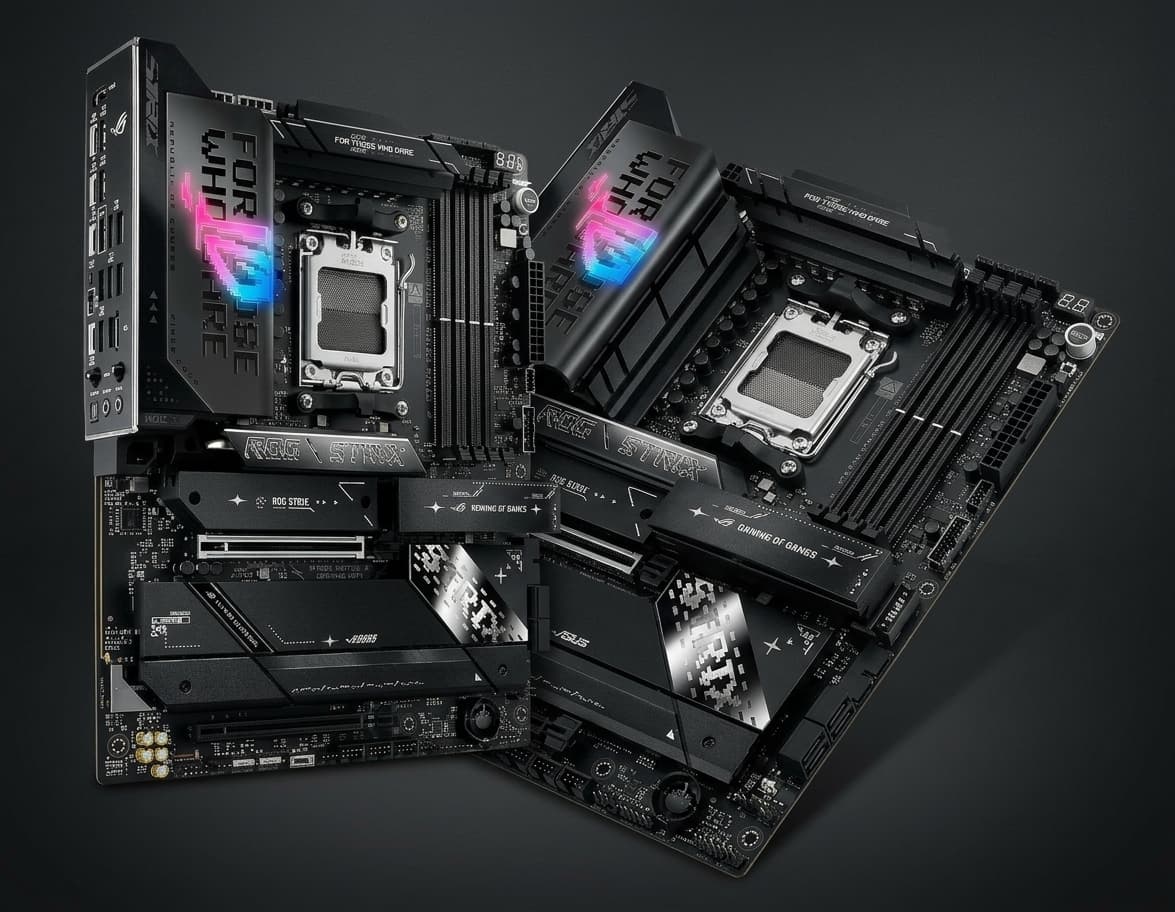
ASUS ROG Strix X870E-E Gaming WiFi
A premium AMD X870E ATX motherboard for AM5 Ryzen 9000, 8000 and 7000 CPUs. It pairs 18+2+2 power stages (110A VCORE) with four DDR5 slots (up to 256GB, EXPO and AEMP), a PCIe 5.0 x16 graphics slot and five M.2 slots, three of them PCIe 5.0. Connectivity includes Wi-Fi 7, Realtek 5Gb Ethernet and dual USB4. It suits enthusiasts building storage-heavy, high-end gaming PCs.
As an Amazon Associate I earn from qualifying purchases. This review is based on official specifications; GearNexis did not physically test this motherboard.
ASUS ROG Strix X870E-E Gaming WiFi Review: Introduction
The ASUS ROG Strix X870E-E Gaming WiFi is a high-end gaming motherboard for AMD's AM5 platform, built on the top X870E chipset. It targets builders pairing an AM5 motherboard for Ryzen 9000 with a fast GPU and several NVMe drives. It stands out among ASUS X870E motherboards for five M.2 slots (three PCIe 5.0), dual USB4, Wi-Fi 7, 5Gb Ethernet and 18+2+2 power stages. No board is the best X870E motherboard for everyone, so this review explains who gets real value from it and who doesn't.
ASUS ROG Strix X870E-E Gaming WiFi: Overview
X870E is AMD's premium AM5 chipset. It mandates USB4 and PCIe 5.0 graphics and storage, and uses two chipset chips for more downstream lanes than X870. The ASUS ROG Strix X870E-E Gaming WiFi sits below ASUS's ROG Crosshair line, but covers what most enthusiasts need:
- Power delivery: 18+2+2 stages for stable high-core-count Ryzen loads.
- Memory: Four DDR5 slots, up to 256GB, with EXPO and AEMP profiles.
- Expansion and storage: PCIe 5.0 x16 graphics, five M.2 slots and four SATA ports.
- Connectivity: Wi-Fi 7, 5GbE, two USB4 ports and 13 rear USB ports.
- DIY features: Tool-free GPU and SSD release, Q-Code diagnostics and BIOS FlashBack.
Key Specifications
| Specification | Details |
|---|---|
| Socket / chipset | AMD AM5 / AMD X870E |
| CPU support | Ryzen 9000, 8000 and 7000 Series desktop |
| Form factor | ATX, 30.5 x 24.4 cm |
| Power stages | 18 (110A) VCORE + 2 (110A) SoC + 2 (80A) MISC |
| Memory | 4 x DDR5, up to 256GB; 8000+ MT/s OC (Ryzen 9000/7000) |
| PCIe | 1 x PCIe 5.0 x16 (CPU); 1 x PCIe 4.0 x4 (chipset) |
| M.2 | 3 x PCIe 5.0 x4 (CPU), 2 x PCIe 4.0 x4 (chipset) |
| SATA | 4 x 6Gb/s |
| Networking | Wi-Fi 7 2x2 (320MHz), Bluetooth 5.4, Realtek 5GbE |
| Rear USB | 2 x USB4 40Gbps, 1 x 20Gbps Type-C (30W PD), 10 x 10Gbps |
| Video / audio | HDMI, DP via USB4; SupremeFX ALC4080, optical S/PDIF |
Design and Build Quality
The board uses a standard ATX layout on an eight-layer PCB with dark ROG styling and Aura Sync RGB. Two VRM heatsinks joined by a heatpipe cover the power stages. All five M.2 slots have heatsinks; the main slot gets a heat-pipe Combo-Sink, with an M.2 backplate and a 60mm fan mount for hot PCIe 5.0 SSDs. The I/O shield is pre-mounted, the two 8-pin ProCool II CPU connectors sit at the top edge, and three addressable Gen 2 RGB headers handle lighting. Q-Code, Q-LEDs and rear BIOS buttons are easy to reach, so assembly and troubleshooting are straightforward.
Power Delivery: 18+2+2 Power Stages
"18+2+2" means 18 stages feed the CPU cores, 2 feed the SoC (memory controller and Infinity Fabric), and 2 handle auxiliary rails. ASUS rates the VCORE and SoC stages at 110A and the MISC stages at 80A, so the "up to 110A" marketing line doesn't cover every stage.
More phases don't make a CPU faster. A strong VRM adds headroom, letting a 16-core Ryzen 9 sustain all-core or PBO loads while running cooler. Results still depend on BIOS power limits and cooling. For a Ryzen 7 9800X3D gaming build, it's more VRM than needed; enthusiasts tuning a Ryzen 9 benefit most. Dynamic OC Switcher swaps between a manual overclock and PBO based on current and temperature thresholds, Core Flex sets condition-based power limits, and AI Overclocking suggests settings. Overclocking can void AMD's CPU warranty.
CPU Compatibility and AM5 Support
The board supports Ryzen 7000, 8000 and 9000 Series desktop processors on AM5. Check ASUS's CPU support list for your exact model and minimum BIOS version; BIOS FlashBack updates firmware without a CPU installed. Features depend on the CPU:
- Ryzen 9000/7000: PCIe 5.0 x16 graphics and all three PCIe 5.0 M.2 slots.
- Ryzen 8000: Graphics slot at PCIe 4.0 x8 or x4; M.2_1 at PCIe 4.0; M.2_2 and M.2_3 disabled.
See our AMD Ryzen CPU and motherboard compatibility guide and Ryzen 7 9800X3D review.
DDR5 Memory and AEMP
Four DDR5 slots support up to 256GB (ECC and non-ECC unbuffered). ASUS rates overclocking at 8000+ MT/s with Ryzen 9000/7000 and 8400+ MT/s with Ryzen 8000, typically with two modules; four DIMMs run slower. Speed depends on the CPU, kit, BIOS and configuration. AMD EXPO applies rated profiles, AEMP tunes kits without EXPO, and NitroPath DRAM slots add up to 400 MT/s of headroom, per ASUS. A 2x16GB DDR5-6000 EXPO kit suits most gaming builds; browse DDR5 memory.
PCIe 5.0 and Expansion
The primary PCIe 5.0 x16 slot comes from the CPU and is reinforced. Today's GPUs show little gaming difference between PCIe 5.0 and 4.0 at x16, so treat it as future headroom. The second slot runs PCIe 4.0 x4 from the chipset, fine for a capture card or NIC but not a second GPU.
Lane sharing: a drive in M.2_2 or M.2_3 drops the graphics slot to x8. PCIe 5.0 x8 equals PCIe 4.0 x16 bandwidth, so the impact is usually small. Q-Release Slim frees the GPU when you tilt it toward the latch, which helps with large cards.
Five M.2 Slots and Storage
| Slot | Interface | Source | Notes |
|---|---|---|---|
| M.2_1 | PCIe 5.0 x4 | CPU | Up to 2280; PCIe 4.0 with Ryzen 8000 |
| M.2_2 | PCIe 5.0 x4 | CPU | Up to 2280; GPU slot to x8 |
| M.2_3 | PCIe 5.0 x4 | CPU | Up to 22110; GPU slot to x8 |
| M.2_4 | PCIe 4.0 x4 | Chipset | 2280 |
| M.2_5 | PCIe 4.0 x4 | Chipset | 2280 |
Only three slots are PCIe 5.0. To keep the GPU at x16, fill M.2_1, M.2_4 and M.2_5 first. Four SATA ports handle older drives, and RAID 0/1/10 is supported on NVMe and SATA (RAID 5 with Ryzen 9000 only). Our NVMe SSD buying guide explains when PCIe 5.0 drives make sense.
Wi-Fi 7, 5Gb Ethernet and Networking
The 2x2 Wi-Fi 7 module supports 2.4/5/6GHz, 320MHz channels and Multi-Link Operation, rated up to 6.5Gbps. Real speeds are lower and need a Wi-Fi 7 router and Windows 11 24H2 or later; there's no Windows 10 driver, and 6GHz availability varies by country. Bluetooth 5.4 is included, though ASUS notes the version may vary by module. Realtek 5GbE only beats 2.5GbE with a multi-gig switch, router or NAS; on gigabit internet it mainly speeds up local transfers. The Q-Antenna and AI Networking II tools add convenience.
USB4 and Connectivity
Rear I/O: two USB4 40Gbps Type-C ports (with DisplayPort output on CPUs with integrated graphics), a USB 20Gbps Type-C port with up to 30W Power Delivery, ten USB 10Gbps ports (nine Type-A, one Type-C), HDMI, two audio jacks and optical S/PDIF.
Front-panel headers (case connectors required): one USB 20Gbps Type-C, four USB 5Gbps and six USB 2.0 ports. Audio uses ROG SupremeFX (Realtek ALC4080) with a Savitech amplifier and headphone impedance sensing.
Cooling and DIY-Friendly Features
- Cooling: Heatpipe-linked VRM heatsinks and heatsinks on all five M.2 slots.
- Fan headers: CPU, CPU OPT, AIO pump and five chassis headers (4-pin), with AI Cooling II tuning.
- M.2 Q-Release and Q-Latch: Tool-free SSD installation.
- Q-Code and Q-LED: Show where a failed boot stopped.
- BIOS FlashBack and Clear CMOS: Rear buttons for updates and recovery.
- Q-Antenna and Q-Release Slim: Faster antenna and GPU installation.
Pair a Ryzen 9 with a strong cooler such as the Arctic Liquid Freezer III Pro 360 or Noctua NH-D15 chromax.black.
Gaming and Productivity Suitability
A motherboard doesn't set your FPS; performance depends mainly on the CPU, GPU, RAM, cooling, software and settings. This board adds platform capability:
- High-end and Ryzen 9000 gaming: A strong base for a 9800X3D and flagship GPU.
- Content creation and video editing: Separate NVMe drives for footage, cache and exports, plus USB4 external SSDs. The Ryzen 9 9950X3D is a good match.
- Streaming: The x4 slot fits a capture card; 5GbE speeds NAS transfers.
- Workstations and enthusiast builds: Ideal for single-GPU work; multi-card setups need two CPU x16 slots.
Planning a system? See our gaming PC build guide.
Competitor Comparison
All five use the X870E chipset, DDR5 (4 slots, 256GB), a PCIe 5.0 x16 graphics slot, two USB4 ports and Wi-Fi 7. Unconfirmed specs are marked "Not verified."
| Board | Form factor | Power | M.2 (Gen5) | Ethernet | Rear USB | Best for |
|---|---|---|---|---|---|---|
| ASUS ROG Strix X870E-E Gaming WiFi | ATX | 18+2+2, 110A | 5 (3) | 5GbE | 13 | Storage-heavy gaming |
| MSI MEG X870E ACE MAX | ATX | 110A; phases not verified | 5 (2) | 10GbE + 5GbE | 13 | Dual LAN, premium audio |
| GIGABYTE X870E AORUS MASTER | ATX | 16+2+2; rating not verified | 4 (3) | 5GbE | 12 | Extra x4 slots |
| ASRock X870E Taichi Lite | E-ATX | 24+2+1 SPS | 4 (1) | 5GbE | 12 | Six SATA, two x16 slots |
| ASUS ProArt X870E-CREATOR WIFI | ATX | 16+2+2; rating not verified | 4 (2) | 10GbE + 2.5GbE | 11 | Creators, multi-card |
Prices change often, so compare current listings; we don't rank value without verified pricing.
vs MSI MEG X870E ACE MAX
The MSI MEG X870E ACE MAX is MSI's current MEG ACE model (the original MEG X870E ACE is no longer listed by MSI). It adds Marvell 10GbE alongside 5GbE, an ESS DAC and a second CPU-connected slot for x8/x8 cards. However, only two of its five M.2 slots are PCIe 5.0, and by default a drive in M.2_2 drops its USB4 ports to a PCIe x2 link. Choose the MSI for 10GbE or two expansion cards; choose the ASUS for three Gen5 M.2 slots without a USB4 trade-off.
vs GIGABYTE X870E AORUS MASTER
The GIGABYTE X870E AORUS MASTER is the closest match: three Gen5 M.2 slots with the same x8 graphics-slot rule, plus two extra chipset x4 slots and a front HDMI header. It has four M.2 slots instead of five, and its rear panel has four 10Gbps Type-A ports versus the Strix's ten 10Gbps ports. Choose GIGABYTE for extra expansion slots; choose ASUS for the fifth M.2 slot and faster rear USB.
vs ASRock X870E Taichi Lite
The ASRock X870E Taichi Lite is E-ATX (30.5 x 26.7 cm), so check case support first. It offers two CPU-connected PCIe 5.0 x16 slots (x8/x8), six SATA ports, a 24+2+1 VRM and an ESS SABRE DAC, but just one Gen5 M.2 slot among four. Choose ASRock for SATA-heavy or dual-card builds; choose ASUS for Gen5 storage in a standard ATX case.
vs ASUS ProArt X870E-CREATOR WIFI
The ASUS ProArt X870E-CREATOR WIFI is ASUS's creator board: two PCIe 5.0 x16 slots (x8/x8), Marvell 10GbE plus Intel 2.5GbE, and a sober design. It has four M.2 slots (two Gen5) and a Realtek ALC1220P codec. Choose the ProArt for multi-card workstations; choose the Strix for storage-heavy gaming builds with SupremeFX audio.
Who Should Buy the ASUS ROG Strix X870E-E?
The ASUS ROG Strix X870E-E Gaming WiFi suits:
- Enthusiast Ryzen builders who use advanced tuning and overclocking.
- Users who need three or more NVMe drives.
- Owners of USB4 docks, external SSDs or USB-C displays.
- Builders who want Wi-Fi 7 and 5Gb Ethernet.
- High-end gaming PC builders.
Who Should Avoid It?
- Budget gaming builds: A B650 or B850 board like the ROG Strix B850-A runs the same CPUs for less.
- Light storage needs: Five M.2 slots add little for one or two SSDs; an X670E or B850 board may suffice.
- No USB4 or multi-gig needs: These are much of the X870E premium.
- Stock-settings users: The VRM and tuning tools go unused.
- Basic networking: If Wi-Fi 6E and 2.5GbE are enough, a cheaper board saves money.
Compare more in our motherboards section.
Final Verdict
The ASUS ROG Strix X870E-E Gaming WiFi is one of the most complete ATX boards on AM5. Its biggest strengths are three Gen5 M.2 slots out of five, dual USB4, Wi-Fi 7 with 5GbE, a robust VRM, 13 rear USB ports and practical DIY features. Its limitations are premium pricing, the x8 rule for M.2_2 and M.2_3, a PCIe 4.0 x4 secondary slot, no 10GbE and reduced storage with Ryzen 8000.
Enthusiasts and high-end gamers who use its storage, connectivity and tuning get the most value; mainstream gamers will do better with B850. Before buying, verify CPU and BIOS support, plan your M.2 layout, confirm case connectors and compare current prices.
Pros
- Five M.2 slots, with three CPU-connected PCIe 5.0 x4 slots on Ryzen 9000 and 7000.
- 18+2+2 power stages, with 110A VCORE and SoC stages, give plenty of headroom for 16-core Ryzen 9 CPUs.
- Two rear USB4 40Gbps ports plus a 20Gbps Type-C port with 30W Power Delivery.
- 13 rear USB ports, including ten at 10Gbps.
- Wi-Fi 7 (320MHz, MLO), Bluetooth 5.4 and Realtek 5Gb Ethernet.
- DDR5 up to 256GB with AMD EXPO, ASUS AEMP and NitroPath DRAM.
- Dynamic OC Switcher, Core Flex and AI Overclocking for advanced tuning.
- Q-Release Slim, M.2 Q-Latch, Q-Code, BIOS FlashBack and Clear CMOS make building and recovery easier.
- Heatsinks on all five M.2 slots, plus a backplate and a 60mm fan mount.
Cons
- Premium pricing; mainstream gamers get similar gaming performance from cheaper B850 boards.
- Using M.2_2 or M.2_3 drops the PCIe 5.0 graphics slot to x8.
- The secondary PCIe slot runs only at PCIe 4.0 x4 through the chipset, so it is not suitable for a second GPU.
- With Ryzen 8000 APUs, M.2_2 and M.2_3 are disabled and the graphics slot falls to PCIe 4.0 x8 or x4.
- No 10GbE; the 5GbE port needs multi-gig network equipment to benefit.
- Full Wi-Fi 7 needs Windows 11 24H2 or later, and there is no Windows 10 driver.
- Rated 8000+ MT/s memory speeds are not reachable with every kit or with four DIMMs.
Spec Sheet
Specifications
General
| Brand | ASUS |
|---|---|
| Model | ROG Strix X870E-E Gaming WiFi |
| Series | ROG Strix |
| ASIN | B0DDZNZF76 |
| Operating System | Windows 11 64-bit |
CPU Compatibility
| Socket | AMD AM5 |
|---|---|
| Supported Processors | AMD Ryzen 9000, 8000 and 7000 Series desktop processors |
| Note | Check ASUS CPU support list for the minimum BIOS version required |
Chipset
| Chipset | AMD X870E |
|---|---|
| BIOS | 256Mb flash ROM, UEFI AMI BIOS |
Memory
| Type | DDR5, dual-channel |
|---|---|
| DIMM Slots | 4 |
| Maximum Capacity | 256GB |
| ECC | ECC and non-ECC unbuffered DIMMs |
| Rated OC Speed | 8000+ MT/s (Ryzen 9000/7000); 8400+ MT/s (Ryzen 8000) |
| Profiles and Features | AMD EXPO, ASUS AEMP, NitroPath DRAM Technology |
| Note | Achievable speed depends on CPU, memory kit, BIOS and DIMM population |
Expansion Slots
| PCIEX16(G5) | PCIe 5.0 x16 (Ryzen 9000/7000); PCIe 4.0 x8/x4 (Ryzen 8000) |
|---|---|
| Secondary Slot | PCIe 4.0 x16-length, x4 mode (X870E chipset) |
| Lane Sharing | PCIEX16(G5) runs at x8 when M.2_2 and/or M.2_3 is occupied |
| GPU Release | PCIe Slot Q-Release Slim with SafeSlot |
Storage
| M.2 Slots | 5 (M key) |
|---|---|
| M.2_1 | PCIe 5.0 x4 from CPU, 2242/2260/2280 (PCIe 4.0 x4 with Ryzen 8000) |
| M.2_2 | PCIe 5.0 x4 from CPU, 2242/2260/2280 (disabled with Ryzen 8000) |
| M.2_3 | PCIe 5.0 x4 from CPU, 2242/2260/2280/22110 (disabled with Ryzen 8000) |
| M.2_4 | PCIe 4.0 x4 from chipset, 2280 |
| M.2_5 | PCIe 4.0 x4 from chipset, 2280 |
| SATA | 4 x SATA 6Gb/s |
| RAID | AMD RAIDXpert2 RAID 0/1/5/10 for NVMe and SATA (RAID 5 with Ryzen 9000 only) |
Networking
| Wi-Fi | Wi-Fi 7 (802.11be), 2x2, 2.4/5/6GHz, up to 320MHz, up to 6.5Gbps |
|---|---|
| Bluetooth | Bluetooth 5.4 (may vary by module) |
| Ethernet | Realtek 5Gb Ethernet with ASUS LANGuard |
| OS Note | Full Wi-Fi 7 requires Windows 11 24H2 or later; no Windows 10 driver |
USB Connectivity
| Rear USB4 | 2 x USB4 40Gbps Type-C |
|---|---|
| Rear USB 20Gbps | 1 x Type-C, up to 30W PD |
| Rear USB 10Gbps | 10 (9 x Type-A, 1 x Type-C) |
| Front USB 20Gbps | 1 x Type-C header |
| Front USB 5Gbps | 2 headers (4 ports) |
| Front USB 2.0 | 3 headers (6 ports) |
| Video Output | 1 x HDMI (4K@60Hz); DisplayPort 1.4a via USB4 (CPU with integrated graphics required) |
Audio
| Codec | ROG SupremeFX 7.1 (Realtek ALC4080) |
|---|---|
| Amplifier | Savitech SV3H712 |
| Rated SNR | 120dB playback, 110dB recording |
| Outputs | 2 rear gold-plated jacks, optical S/PDIF out, front-panel audio header |
Internal Connectors
| Power | 1 x 24-pin ATX, 2 x 8-pin 12V CPU (ProCool II) |
|---|---|
| Fan Headers | CPU, CPU OPT, AIO pump, 5 x chassis (all 4-pin) |
| RGB | 3 x Addressable Gen 2 headers |
| Other | Thermal sensor header, FlexKey button, Start button, CPU over-voltage jumper, front-panel audio |
Cooling
| VRM | Heatsink array linked by heatpipe |
|---|---|
| M.2 | Heatsinks on all five slots, M.2 Combo-Sink, M.2 backplate, 60mm fan mount |
| Software | Fan Xpert 4 with AI Cooling II |
Special Features
| Power Stages | 18 (110A) VCORE + 2 (110A) SoC + 2 (80A) MISC |
|---|---|
| PCB | 8-layer |
| Tuning | Dynamic OC Switcher, Core Flex, AI Overclocking, PBO Enhancement, Asynchronous Clock |
| Networking Software | AI Networking II |
| DIY | M.2 Q-Latch, M.2 Q-Release, Q-Slide, Q-Code, Q-LED, Q-Antenna, BIOS FlashBack, Clear CMOS, pre-mounted I/O shield |
| Lighting | Aura Sync |
Dimensions
| Form Factor | ATX |
|---|---|
| Size | 30.5 x 24.4 cm (12 x 9.6 in) |
| Case Compatibility | Fits cases that support standard ATX motherboards |
Frequently Asked Questions
Is the ASUS ROG Strix X870E-E Gaming WiFi worth buying?+
Is the ASUS ROG Strix X870E-E compatible with Ryzen 9000 processors?+
Does it support Ryzen 7000 and Ryzen 8000 processors?+
Does the ASUS ROG Strix X870E-E support DDR5 memory?+
How many M.2 SSDs does the ASUS ROG Strix X870E-E support?+
Does this motherboard support PCIe 5.0?+
Does the ASUS ROG Strix X870E-E have Wi-Fi 7?+
Does it include USB4?+
Is the ASUS ROG Strix X870E-E good for gaming?+
What is the difference between X870 and X870E?+
What type of PC case is compatible with this motherboard?+
Is this motherboard suitable for a high-end workstation?+
As an Amazon Associate we earn from qualifying purchases. See our affiliate disclosure.