
Crucial
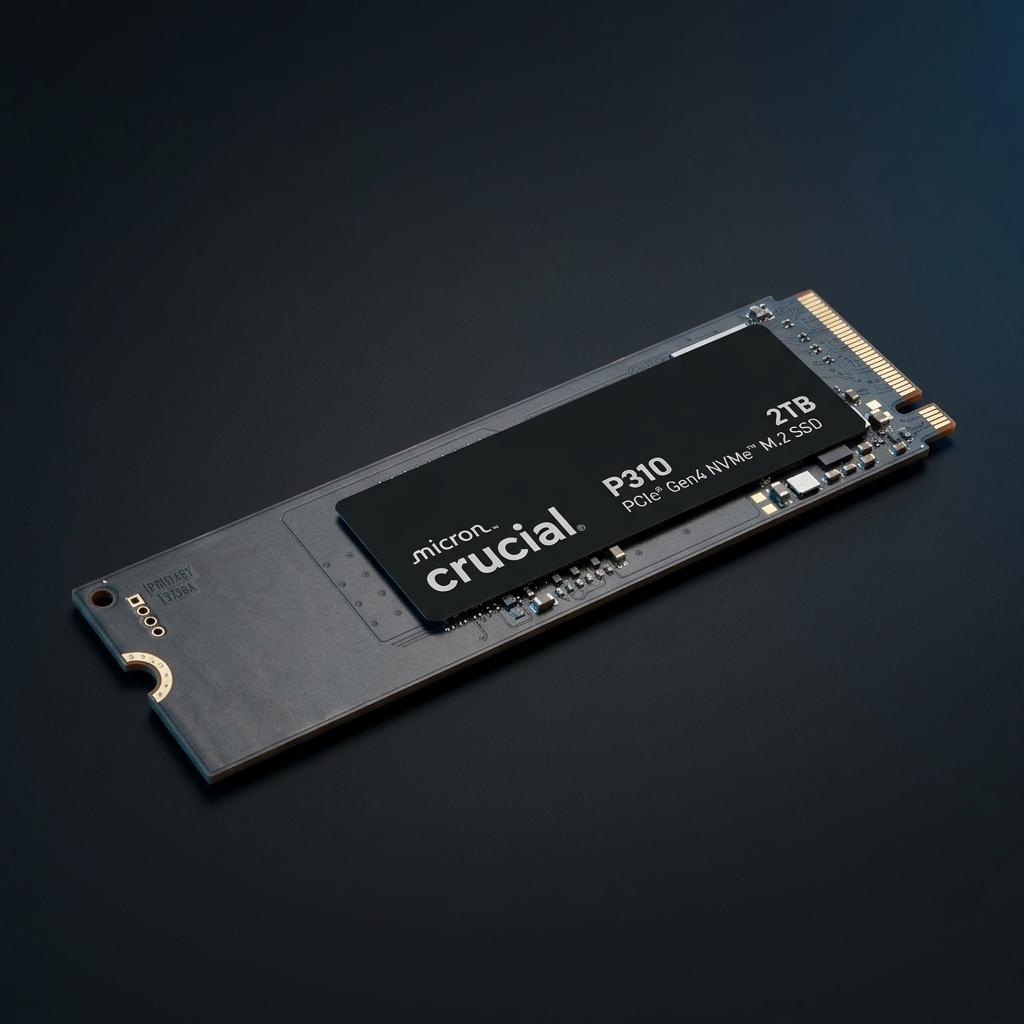
Crucial P310 2TB PCIe Gen4 NVMe M.2 2280 SSD
The Crucial P310 2TB (CT2000P310SSD801) is a PCIe Gen4 NVMe M.2 2280 SSD for desktop PCs and compatible laptops. Crucial rates it at up to 7,100 MB/s sequential read and 6,000 MB/s sequential write. It has 2TB of storage, a five-year limited warranty and advertised Acronis software. It suits gaming libraries, everyday computing and general application storage.
This Crucial P310 2TB review covers the specifications, compatibility, NAND technology and alternatives for the Crucial P310 2TB NVMe SSD. Its model number is CT2000P310SSD801. It is a PCIe Gen4 storage drive for people who want fast storage with plenty of room for games, applications, creative projects and everyday files. Crucial rates this M.2 2280 SSD at up to 7,100 MB/s sequential read and up to 6,000 MB/s sequential write.
This review is based on manufacturer specifications and published information. GearNexis has not run its own benchmarks on this drive.
Crucial P310 2TB Review: Key Features at a Glance
The P310 pairs a PCIe 4.0 x4 interface with the standard M.2 2280 form factor. It is a sensible upgrade for people moving from SATA storage or an older NVMe drive.
- 2TB storage capacity: Space for games, software, documents and media.
- PCIe Gen4 x4 NVMe interface: High-bandwidth storage for compatible systems.
- Up to 7,100 MB/s sequential read: Manufacturer-rated maximum.
- Up to 6,000 MB/s sequential write: Manufacturer-rated maximum.
- M.2 2280 form factor: Standard 22 mm × 80 mm SSD dimensions.
- Acronis software: Advertised for backup, recovery or migration tasks, subject to the included license terms.
- Five-year limited warranty: Subject to Crucial's warranty conditions and the drive's endurance rating.
How Fast Is the Crucial P310 2TB?
Crucial rates the 2TB model at up to 7,100 MB/s read and up to 6,000 MB/s write. Those figures put it in the high-speed tier of PCIe 4.0 drives on paper.
Faster storage can cut file transfer times and help with game loading, application launches and moving large projects. How much difference you notice depends on your software, your system and the drive you are replacing. Upgrading from a hard drive or a SATA SSD is usually a bigger change than upgrading from another NVMe drive.
Advertised sequential speeds are best-case maximums, not guaranteed everyday results. Real performance varies with free space, workload type, temperature, platform and the state of the drive's write cache.
Is 2TB Enough for Gaming and Productivity?
At 2TB, the P310 holds far more than a typical 500GB or 1TB drive. That helps gamers who keep several large titles installed, creators who manage media libraries, and desktop users who want their applications and projects on one internal drive.
Does an NVMe SSD Improve Gaming Performance?
An NVMe SSD gives fast access to installed game files and can reduce storage-related loading delays. It does not directly raise graphics performance or frame rates. Those depend mainly on the CPU, GPU, memory and game engine.
Can It Be Used as a Boot Drive?
Yes. The P310 can serve as an operating-system drive, an application drive or secondary storage, as long as your computer supports its interface and physical size.
Crucial P310 Compatibility: M.2 2280 vs M.2 2230
This model uses the M.2 2280 form factor, which measures about 22 mm wide and 80 mm long. Its PCIe Gen4 x4 NVMe interface needs a compatible M.2 slot.
Check your motherboard or laptop specifications before buying. Not every M.2 slot supports NVMe, and some systems limit drive length, PCIe generation or available lanes. A PCIe 4.0 SSD also works in many PCIe 3.0 slots, but the older platform caps its maximum speed.
Important for handheld gaming devices: Many handheld PCs, including the Steam Deck, use the much shorter M.2 2230 form factor. This 2280 model (CT2000P310SSD801) will not fit a device that needs a 2230 drive. Crucial sells a separate M.2 2230 version of the P310 under a different model number, and this review does not cover it. Confirm the exact drive length your device supports before buying.
QLC NAND, DRAM-less Design and Sustained Writes
The 2TB P310 uses QLC NAND flash and a DRAM-less controller with Host Memory Buffer (HMB) support. This design keeps the drive aimed at mainstream buyers while still delivering high rated sequential speeds.
Sequential figures do not describe every workload. QLC-based SSDs write data to a fast SLC cache first. Once that cache fills during a very large continuous transfer, write speeds can drop sharply. Independent reviews of the P310 2280 have reported a significant fall in sustained write speed after the cache is exhausted.
For typical gaming, everyday computing and mixed desktop use, this limitation matters less than it does for users who regularly write hundreds of gigabytes at a time. Professionals who move large video projects or do frequent sustained transfers should compare the P310 with TLC-based alternatives.
Crucial P310 vs Competing 2TB NVMe SSDs
The table below compares manufacturer-rated specifications for the 2TB versions of popular PCIe 4.0 drives. Rated maximums are not benchmark results, and drives with similar ratings can behave very differently under sustained or random workloads.
| SSD | Capacity | Interface | Max Read | Max Write | Main Consideration |
|---|---|---|---|---|---|
| Crucial P310 2TB | 2TB | PCIe 4.0 x4 | Up to 7,100 MB/s | Up to 6,000 MB/s | QLC, DRAM-less mainstream SSD; 440TBW |
| WD_BLACK SN850X 2TB | 2TB | PCIe 4.0 x4 | Up to 7,300 MB/s | Up to 6,600 MB/s | Performance-focused TLC SSD with DRAM cache; 1,200TBW |
| Samsung 990 PRO 2TB | 2TB | PCIe 4.0 x4 | Up to 7,450 MB/s | Up to 6,900 MB/s | Premium TLC SSD with DRAM cache; 1,200TBW |
| Lexar NM790 2TB | 2TB | PCIe 4.0 x4 | Up to 7,400 MB/s | Up to 6,500 MB/s | DRAM-less TLC SSD with HMB; 1,500TBW |
| Crucial T500 2TB | 2TB | PCIe 4.0 x4 | Up to 7,400 MB/s | Up to 7,000 MB/s | TLC SSD with DRAM cache; 1,200TBW |
What the Comparison Shows
All five drives use PCIe 4.0 x4 and share similar headline sequential ratings. The bigger differences are NAND type, DRAM and endurance. The four competitors use TLC NAND and carry higher TBW ratings than the P310's 440TBW. The SN850X, 990 PRO and T500 also include a DRAM cache. These traits generally favour heavy and sustained write workloads. The P310's QLC design targets mainstream buyers. Compare current prices and independent benchmarks to judge whether the difference matters for how you use your PC.
Acronis Software and Data Migration
The product listing advertises included Acronis software. It can help when you set up a new drive or migrate data, depending on the software version and license supplied.
Check the packaging and Crucial's current software instructions for activation requirements, supported features and license limits. Do not assume every Acronis subscription feature is included indefinitely.
Crucial P310 2TB Warranty and Endurance
Crucial backs the P310 with a five-year limited warranty. The 2TB version is rated for 440TBW (terabytes written) of endurance. TBW describes how much data can be written under the manufacturer's endurance specification. It does not predict the exact lifespan of an individual drive. Warranty coverage typically ends at the warranty period or the TBW rating, whichever comes first, so review Crucial's current warranty terms for your region.
Crucial P310 2TB Review: Final Verdict
The Crucial P310 2TB PCIe Gen4 NVMe SSD combines high rated sequential speeds, 2TB of capacity and a standard M.2 2280 design. Its 7,100 MB/s read and 6,000 MB/s write ratings make it worth considering for compatible desktops and laptops.
Its QLC NAND, DRAM-less design and 440TBW endurance rating are the main trade-offs, especially for users who often perform long, sustained writes. For those workloads, TLC-based drives such as the ones compared above deserve a close look.
If you need a 2TB PCIe 4.0 SSD for gaming, applications and everyday storage, the P310 is a reasonable model to shortlist. Confirm your system's M.2 2280 NVMe support and compare its current price with alternatives before buying.
Pros
- 2TB storage capacity for games, applications and files.
- PCIe 4.0 x4 NVMe interface.
- Rated sequential read speeds up to 7,100 MB/s.
- Rated sequential write speeds up to 6,000 MB/s.
- Standard M.2 2280 form factor.
- Five-year limited manufacturer warranty.
- Includes advertised Acronis software.
Cons
- QLC NAND can have lower sustained write performance once the write cache is exhausted.
- DRAM-less design may not suit every demanding professional workload.
- 2280 length will not fit handheld devices that need M.2 2230 drives.
- Actual performance depends on system compatibility, workload and operating conditions.
- 440TBW endurance is lower than the 1,200–1,500TBW ratings of the TLC competitors compared.
Spec Sheet
Specifications
General
| Product Name | Crucial P310 2TB NVMe SSD |
|---|---|
| Model Number | CT2000P310SSD801 |
| Capacity | 2TB |
| Product Series | Crucial P310 |
Interface
| Interface | PCIe Gen4 x4 |
|---|---|
| Protocol | NVMe |
Form Factor
| Form Factor | M.2 2280 |
|---|
Performance
| Sequential Read | Up to 7,100 MB/s |
|---|---|
| Sequential Write | Up to 6,000 MB/s |
Memory
| NAND Type | QLC NAND |
|---|
Controller
| Controller Design | DRAM-less with HMB support |
|---|
Endurance
| Total Bytes Written | 440TBW |
|---|
Warranty
| Manufacturer Warranty | Five-year limited warranty |
|---|
Software
| Included Software | Acronis software, subject to license terms |
|---|
Frequently Asked Questions
Is the Crucial P310 2TB a good SSD?+
What is the maximum read speed of the Crucial P310 2TB?+
What is the maximum write speed of the Crucial P310 2TB?+
Is the Crucial P310 a PCIe Gen4 SSD?+
Is the Crucial P310 compatible with gaming PCs?+
Can I use the Crucial P310 2280 in a Steam Deck?+
Is the Crucial P310 suitable for laptops?+
Does the Crucial P310 2TB have DRAM?+
Is the Crucial P310 a TLC or QLC SSD?+
What is the endurance rating of the Crucial P310 2TB?+
Does the Crucial P310 include Acronis software?+
Is the Crucial P310 good for gaming?+
Is the Crucial P310 better than the Samsung 990 PRO?+
Is the Crucial P310 worth buying for video editing?+
As an Amazon Associate we earn from qualifying purchases. See our affiliate disclosure.