
ASUS
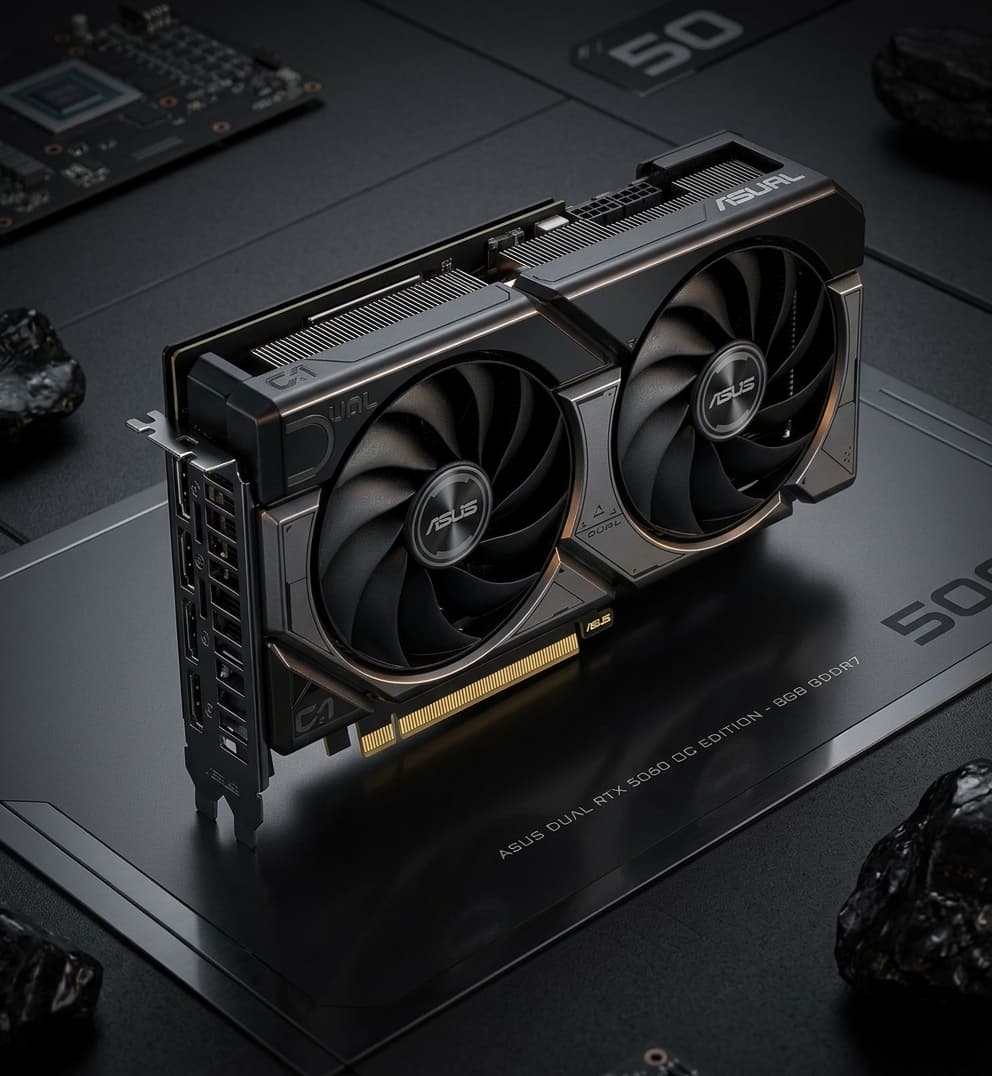
ASUS Dual NVIDIA GeForce RTX 5060 8GB GDDR7 OC Edition
Compact 2.5-slot ASUS Dual RTX 5060 OC (DUAL-RTX5060-O8G) with 8GB of 28 Gbps GDDR7 and a 2565 MHz OC-mode boost. It features dual Axial-tech fans with 0dB fan-stop and DLSS 4 Multi Frame Generation support, and needs a single 8-pin connector and a 550W recommended PSU. Built for 1080p gaming.
As an Amazon Associate I earn from qualifying purchases.
Introduction
This ASUS Dual RTX 5060 8GB GDDR7 OC review covers the ASUS Dual NVIDIA GeForce RTX 5060 8GB GDDR7 OC Edition (DUAL-RTX5060-O8G). It is a compact two-fan, factory-overclocked card that needs one 8-pin connector and a 550W PSU. It is based on ASUS/NVIDIA specs and independent benchmarks (mostly of other RTX 5060 models, which perform within a few percent). We did not test it ourselves.
Quick Verdict
A sensible, compact 1080p card with Blackwell, GDDR7, DLSS 4 Multi Frame Generation and a fan-stop cooler. Independent tests put the RTX 5060 near the RTX 4060 Ti and clearly ahead of the RTX 4060. Its main weakness is 8GB of VRAM, which forces texture and ray-tracing compromises in demanding games, especially above 1080p. For 1440p or long-term use, consider 16GB.
Key Specifications Overview
| Specification | Value |
|---|---|
| GPU / Architecture | GeForce RTX 5060 / Blackwell |
| CUDA cores | 3,840 |
| AI performance | 614 TOPS (5th-gen Tensor, 4th-gen RT cores) |
| Memory | 8GB GDDR7, 28 Gbps, 128-bit, 448 GB/s |
| Boost clock | OC mode 2565 MHz; Default 2535 MHz |
| Bus | PCIe 5.0 (x8 link) |
| Outputs | 1x HDMI 2.1b, 3x DisplayPort 2.1b (up to 4 displays, max 7680x4320) |
| Power | 1x 8-pin; 550W PSU recommended; 145W TGP (NVIDIA reference) |
| Size | 228 x 123 x 50 mm (8.98 x 4.84 x 1.97 in), 2.5-slot |
Design and Build Quality
At about 9 inches long, the card fits most ATX and micro-ATX cases. At 50 mm thick (2.5 slots), it can block the slot below it. ASUS lists these build features:
- A vented backplate for rigidity and airflow
- GPU Guard corner adhesive to reduce cracking risk
- A 304 stainless steel I/O bracket
- Single-pass Auto-Extreme soldering
- A dual BIOS switch with Performance and Quiet modes (Quiet keeps the same power target with a gentler fan curve)
No RGB showcase; the look is understated.
Cooling System and Noise Features
Two Axial-tech fans use longer blades, a smaller hub and a barrier ring to raise air pressure. They run on dual ball bearings, which ASUS rates at up to twice the lifespan of sleeve bearings. With 0dB technology, the fans stop when the GPU is below 50°C and power use is low, so the card is silent during desktop use. No independent thermal or noise tests of this exact model exist yet; TechPowerUp found the 145W RTX 5060 easy to cool even on a single-fan card.
Gaming Performance Analysis
- TechPowerUp (Zotac RTX 5060 Solo, 1080p, no RT or upscaling): roughly equal to the RTX 4060 Ti, about 26% faster than the RTX 4060 and 45% faster than the RTX 3060. The RTX 5060 Ti was about 15% faster.
- GamersNexus (Gigabyte RTX 5060 Eagle OC, native): typically 6–27% faster than the RTX 4060, often around 20%. The RTX 5060 Ti 16GB was 15–25% faster.
TechPowerUp praised the card's value at its $299 launch price. GamersNexus did not recommend it, citing the 8GB of VRAM. GamersNexus also published these native results for a different RTX 5060 model, so treat them as indicative only:
| Game (settings) | 1080p FPS | 1440p FPS |
|---|---|---|
| Cyberpunk 2077: Phantom Liberty (Ultra) | 89 | 55 |
| Starfield (Ultra) | 66 | 52 |
| Dragon's Dogma 2 (Max) | 76 | 57 |
| Black Myth: Wukong (High) | 66 | 46 |
| Resident Evil 4 | — | 91 |
| Dying Light 2 (High-Custom) | — | 62 |
1080p Gaming Experience
1080p is this card's home. TechPowerUp called it "really the only resolution" for the RTX 5060, and reported a good experience in every game tested once settings were tuned. Esports titles such as Counter-Strike 2, Valorant, Fortnite and Apex Legends suit high-refresh monitors well. In demanding games, tune individual settings (especially textures, which drive VRAM use) instead of Ultra presets, or let the NVIDIA App optimize them.
1440p Gaming Considerations
Lighter games run well at 1440p, but modern AAA titles usually need DLSS and lower textures or ray tracing. In TechPowerUp's tests, the RTX 5060 trailed the RX 9060 XT 8GB by about 3% at 1080p, 5% at 1440p and 17% at 4K. It trailed the RX 9060 XT 16GB by about 15% at 1440p. TechPowerUp suggests the x8 PCIe link plays a part, because VRAM overflow travels over half the bandwidth of the Radeon's x16 link. For 1440p AAA gaming, a 16GB card is safer.
Ray Tracing, DLSS 4, and Frame Generation
- Native rendering: every pixel is rendered at your resolution. This is how the benchmarks above were measured.
- Upscaling (DLSS Super Resolution): renders at a lower resolution and uses AI to reconstruct the image. It raises FPS and responsiveness, and DLSS 4's transformer model improves image quality.
- Frame generation: inserts AI frames between rendered frames. Motion looks smoother, but it doesn't make the game respond faster and can add latency. RTX 50 cards support Multi Frame Generation, while RTX 40 cards support single frame generation only.
NVIDIA's own claims use DLSS plus MFG, so they aren't comparable to native benchmarks. The card supports DLSS 4 (Super Resolution, DLAA, Ray Reconstruction, Frame Generation and Multi Frame Generation) and NVIDIA Reflex. TechPowerUp often preferred 2x frame generation, since 3x and 4x sometimes added noticeable latency. It also noted that frame generation uses extra VRAM. Ray tracing at high settings can exceed 8GB even at 1080p: Indiana Jones crashed at max textures. RT works with tuning and DLSS, not maxed out.
Is 8GB VRAM Enough?
Fine for: esports, older and mid-weight AAA games at 1080p, and new AAA games at 1080p with lower textures and limited ray tracing.
A problem for: maximum textures in recent AAA games, ray tracing with high textures, 1440p and 4K in demanding titles, and frame generation on top of high VRAM use.
Running out of VRAM causes stutter, pop-in, FPS drops and some Vulkan crashes. TechPowerUp saw RTX 50 8GB cards degrade "sooner and harder" than some rivals (newer drivers helped) and considers 12GB a better fit. Neural texture compression may help later, but few games use it.
Streaming and Content Creation
A ninth-generation NVENC encoder (H.264, HEVC and AV1) and a sixth-generation NVDEC decoder let you stream and record in OBS, Discord or the NVIDIA App with little performance cost. They also speed up Resolve and Premiere Pro, with Studio Driver, CUDA and Tensor support for Blender and AI effects. But 8GB limits big 3D scenes, heavy timelines and local AI; the RTX 5060 Ti 16GB fits better.
Power Requirements and Compatibility
- PSU: 550W recommended, which ASUS notes assumes a fully overclocked system. Use a quality unit with a native 8-pin cable.
- Connector: one 8-pin PCIe. No 16-pin cable is needed.
- PCIe: an x16 slot with an x8 PCIe 5.0 link. This is fine on PCIe 4.0 and 5.0. On PCIe 3.0, bandwidth is reduced, which hurts most when VRAM overflows.
- Case: needs room for 228 mm length, 123 mm height and 50 mm thickness.
- Displays: three DP 2.1b and one HDMI 2.1b output support up to four monitors. HDMI 2.1b suits high-refresh TVs.
- CPU: a modern CPU helps at high refresh rates at 1080p.
ASUS Dual RTX 5060 vs Competitors
Figures come from independent reviews, often of other partner models. MSRPs are historical launch prices.
RTX 5060 vs RTX 4060
Compared: Gigabyte GeForce RTX 4060 WINDFORCE OC 8G. The RTX 4060 is an Ada card with 3,072 cores and 8GB GDDR6 at 272 GB/s, compared with 448 GB/s on the RTX 5060. The RTX 5060 is about 26% faster (TechPowerUp) or about 20% faster (GamersNexus). The 4060 draws less power (115W) and supports single frame generation only. Choose it only if it's much cheaper or you need a shorter card.
RTX 5060 vs RTX 5060 Ti 8GB
Compared: PNY GeForce RTX 5060 Ti 8GB OC Dual-Fan. It uses the same GB206 chip with 4,608 cores, the same 8GB GDDR7 and the same DLSS 4 features. It is about 15% faster at 1080p (TechPowerUp), with a 180W rating and a 600W PSU recommendation. The shared 8GB limit narrows the gap in memory-heavy games, so most should pick the 16GB version.
RTX 5060 vs RTX 5060 Ti 16GB
Compared: ASUS Dual GeForce RTX 5060 Ti 16GB GDDR7 OC Edition. This is the most direct upgrade, at 15–25% faster (GamersNexus) with double the memory. None of TechPowerUp's test games had trouble with 16GB, even with ray tracing or path tracing. It is the better choice for 1440p, ray tracing, content creation and longevity. The trade-offs are a $429 launch MSRP (compared with $299), 180W and a 600W PSU.
RTX 5060 vs Radeon RX 9060 XT 8GB
Compared: ASUS Prime Radeon RX 9060 XT 8GB GDDR6 OC Edition. Both cards launched at $299. TechPowerUp measured the Radeon about 3% faster at 1080p (effectively a tie), 5% faster at 1440p and 17% faster at 4K. It uses slower GDDR6 (320 GB/s) but a PCIe 5.0 x16 link, which helps when VRAM overflows. It even beat the RTX 5060 Ti 8GB in ray tracing. The RTX 5060 counters with DLSS 4 (rated above FSR 4 by TechPowerUp and in more games), lower power (145W vs ~150W) and NVENC.
RTX 5060 vs Radeon RX 9060 XT 16GB
Compared: XFX Swift Radeon RX 9060 XT OC Triple Fan Gaming Edition 16GB. This card launched at $349, and TechPowerUp measured it about 11% faster than the RTX 5060 at 1080p and 15% faster at 1440p, nearly matching the RTX 5060 Ti 16GB. GamersNexus also pointed buyers toward it. With 16GB and about 160W, it has far more headroom. The triple-fan XFX is longer, so check case fit. Pick the GeForce only if DLSS 4, NVENC or compact size matter most.
Detailed Competitor Comparison Table
| GPU | Arch | VRAM | Bandwidth | PCIe | Power | PSU | Upscaling / FG | vs RTX 5060 | Launch MSRP | Best for |
|---|---|---|---|---|---|---|---|---|---|---|
| ASUS Dual RTX 5060 OC | Blackwell | 8GB GDDR7 | 448 GB/s | 5.0 x8 | 145W | 550W | DLSS 4 + MFG | Baseline | $299 | Compact 1080p |
| RTX 4060 | Ada | 8GB GDDR6 | 272 GB/s | 4.0 x8 | 115W | 550W | DLSS, single FG | ~21% slower | $299 | Low-power budget builds |
| RTX 5060 Ti 8GB | Blackwell | 8GB GDDR7 | 448 GB/s | 5.0 x8 | 180W | 600W | DLSS 4 + MFG | ~15% faster | $379 | More 1080p speed |
| RTX 5060 Ti 16GB | Blackwell | 16GB GDDR7 | 448 GB/s | 5.0 x8 | 180W | 600W | DLSS 4 + MFG | ~15–25% faster | $429 | 1440p, RT, creators |
| RX 9060 XT 8GB | RDNA 4 | 8GB GDDR6 | 320 GB/s | 5.0 x16 | ~150W | Check maker | FSR 4, AMD FG | ~3% / 5% faster (1080p/1440p) | $299 | Same-price rival |
| RX 9060 XT 16GB | RDNA 4 | 16GB GDDR6 | 320 GB/s | 5.0 x16 | ~160W | Check maker | FSR 4, AMD FG | ~11% / 15% faster (1080p/1440p) | $349 | Value with VRAM headroom |
Sources: native, no-RT averages from TechPowerUp's RTX 5060 (Zotac Solo), RX 9060 XT Reaper 8GB and RX 9060 XT Prime OC 16GB reviews, and the 5060 Ti 16GB range from GamersNexus. The figures come from separate reviews, so treat them as approximate. Power and PSU figures are NVIDIA and AMD reference values.
Who Should Consider This Graphics Card?
- 1080p gamers, especially those with 144–180Hz monitors
- Esports players who want high FPS and Reflex
- Upgraders from GTX 10/16-series, RTX 20-series, RTX 3050 or RTX 3060 cards
- Builders with a 550W PSU and an 8-pin cable
- Small and mid-size cases that need a roughly 9-inch, two-fan card
- Players who want DLSS 4 Multi Frame Generation
- Budget streamers who want AV1 NVENC
Who Should Consider an Alternative?
- 1440p AAA gamers: the RTX 5060 Ti 16GB or RX 9060 XT 16GB
- Max-texture and ray-tracing fans: a 16GB card
- Long-term owners: more VRAM ages better
- 3D, video and local-AI creators: the RTX 5060 Ti 16GB
- PCIe 3.0 owners: the RX 9060 XT's x16 link suffers less
- RTX 4060 Ti or 3060 Ti owners: the upgrade is too small
Price and Value Analysis
The RTX 5060 launched in May 2025 at $299. Partner OC cards sell above or below that, and Amazon prices change often, so check the current price on Amazon.
- Near the RX 9060 XT 8GB price: it's a tie at 1080p, so choose between DLSS 4 and the Radeon's better 8GB behavior.
- Within about $50 of the RX 9060 XT 16GB: the Radeon is the better value.
- Close to the RTX 5060 Ti 16GB: buy the Ti.
- At or below $299: a reasonable compact 1080p card with full DLSS 4.
What to Check Before Buying
- Case: 228 mm length, 123 mm height, 2.5-slot (50 mm) thickness
- PSU: a reputable 550W or larger unit with a free 8-pin
- Motherboard: an x16 slot, ideally PCIe 4.0 or 5.0
- Monitor: 1080p, with the right DP or HDMI cable for high refresh rates
- Games: the VRAM needs of your titles
- Model: make sure it's DUAL-RTX5060-O8G (OC Edition)
- Warranty: the listing says 3 years, so confirm the US terms with ASUS and keep your receipt
- Software: the latest Game Ready or Studio Driver, plus GPU Tweak III from ASUS support
Final Verdict
The ASUS Dual RTX 5060 8GB GDDR7 OC is a well-built, compact way to bring Blackwell performance to a 1080p PC. It runs near RTX 4060 Ti performance and about 20–26% faster than the RTX 4060. ASUS adds a mild OC, 0dB Axial-tech cooler, vented backplate, dual BIOS and simple 8-pin, 550W needs. The 8GB of VRAM means tuning, limited RT, modest 1440p and less headroom than 16GB rivals. At the right price it suits 1080p gamers who value DLSS 4 and NVENC; a 16GB card is more future-proof.
Check the ASUS Dual RTX 5060 8GB GDDR7 OC Edition price on Amazon
Specs from ASUS/NVIDIA may change. Performance is from the named sources on other RTX 5060 models; results vary.
Pros
- Compact 228 mm (about 9-inch) length that fits most ATX and micro-ATX cases
- Fast 8GB GDDR7 memory at 28 Gbps (448 GB/s), well above the RTX 4060's GDDR6
- Independent tests place RTX 5060 performance near the RTX 4060 Ti and about 20–26% above the RTX 4060 at 1080p
- Full DLSS 4 support, including Multi Frame Generation, Ray Reconstruction, and the transformer upscaling model
- Simple power needs: one 8-pin connector and a 550W recommended PSU
- Two Axial-tech fans with dual ball bearings and 0dB fan-stop below 50°C at low load
- Vented backplate, GPU Guard corner adhesive, and a stainless steel I/O bracket
- Dual BIOS switch with Performance and Quiet modes
- Three DisplayPort 2.1b outputs and one HDMI 2.1b output, supporting up to four displays
- Ninth-generation NVENC with AV1 encoding for streaming and recording
Cons
- 8GB of VRAM requires lower textures or ray tracing settings in demanding new games
- Primarily a 1080p card, since modern AAA games at 1440p need upscaling and compromises
- PCIe 5.0 x8 link, so performance drops harder when VRAM overflows, especially on PCIe 3.0 boards
- Ray tracing at high settings can exceed 8GB even at 1080p, according to TechPowerUp
- Trails the Radeon RX 9060 XT 16GB by about 11% at 1080p and about 15% at 1440p in TechPowerUp testing
- 2.5-slot thickness can block the adjacent expansion slot
- Limited VRAM for heavy 3D, video, or local AI workloads compared with 16GB cards
Spec Sheet
Specifications
General
| Brand | ASUS |
|---|---|
| Product Series | Dual |
| Model Number | DUAL-RTX5060-O8G |
| Amazon ASIN | B0F8PR9L3X |
| Release Year | 2025 |
GPU
| Graphics Engine | NVIDIA GeForce RTX 5060 |
|---|---|
| Architecture | NVIDIA Blackwell |
| CUDA Cores | 3840 |
| AI Performance | 614 AI TOPS |
| Tensor Cores | 5th Generation |
| RT Cores | 4th Generation |
| OpenGL | OpenGL 4.6 |
| Supported Technologies | DLSS 4 (Super Resolution, DLAA, Ray Reconstruction, Frame Generation, Multi Frame Generation), NVIDIA Reflex |
Memory
| Video Memory | 8GB |
|---|---|
| Memory Type | GDDR7 |
| Memory Speed | 28 Gbps |
| Memory Interface | 128-bit |
| Memory Bandwidth | 448 GB/s |
Clock Speeds
| Boost Clock (OC Mode) | 2565 MHz |
|---|---|
| Boost Clock (Default Mode) | 2535 MHz |
Connectivity
| Bus Interface | PCI Express 5.0 (x8 electrical link) |
|---|---|
| HDMI | 1 x HDMI 2.1b |
| DisplayPort | 3 x DisplayPort 2.1b |
| HDCP | 2.3 |
Display
| Maximum Digital Resolution | 7680 x 4320 |
|---|---|
| Maximum Displays | 4 |
Cooling
| Fan Design | 2 x Axial-tech fans |
|---|---|
| Fan Bearings | Dual ball bearings |
| 0dB Technology | Fans stop below 50°C GPU temperature at low power |
| Backplate | Vented backplate |
| BIOS | Dual BIOS (Performance / Quiet) |
Physical Dimensions
| Dimensions (mm) | 228 x 123 x 50 mm |
|---|---|
| Dimensions (in) | 8.98 x 4.84 x 1.97 in |
| Slot Size | 2.5 slot |
Power
| Power Connector | 1 x 8-pin PCIe |
|---|---|
| Recommended PSU | 550W |
| Total Graphics Power (NVIDIA reference) | 145W |
Warranty
| Warranty Period | 3 years (per Amazon listing; confirm US terms with ASUS) |
|---|
Frequently Asked Questions
Is the ASUS Dual RTX 5060 8GB good for 1080p gaming?+
Is 8GB of VRAM enough for modern games?+
Can the RTX 5060 run games at 1440p?+
What power supply does the ASUS Dual RTX 5060 OC need?+
Does the RTX 5060 support DLSS 4?+
What display outputs does the ASUS Dual RTX 5060 OC have?+
How big is the ASUS Dual RTX 5060 OC?+
Should I buy the RTX 5060 or the RTX 5060 Ti?+
As an Amazon Associate we earn from qualifying purchases. See our affiliate disclosure.