
ASUS
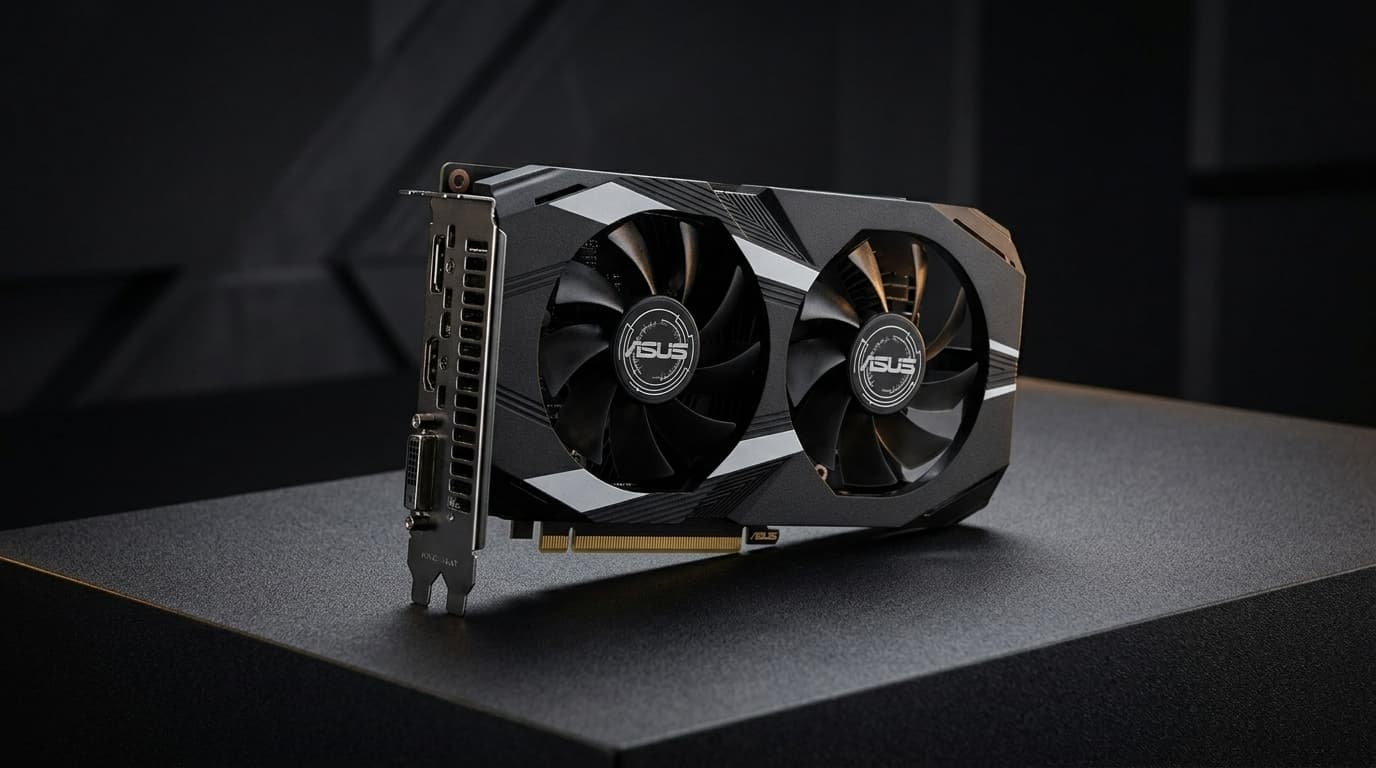
ASUS Dual NVIDIA GeForce RTX 3050 6GB OC Edition Gaming Graphics Card
A compact, two-slot graphics card built on NVIDIA’s Ampere architecture with 6GB of GDDR6 memory, DLSS support, and HDMI 2.1. It runs entirely on PCIe slot power with no extra power cable, so it’s a practical upgrade for budget gaming PCs and office prebuilts that aim for 1080p gaming at sensible settings.
This review is based on manufacturer specifications and published independent testing; GearNexis Official did not run its own benchmarks on this card.
ASUS Dual RTX 3050 6GB OC Review: A Slot-Powered Card for Budget 1080p Gaming
The ASUS Dual NVIDIA GeForce RTX 3050 6GB OC Edition (model DUAL-RTX3050-O6G) targets one specific buyer: someone who wants modern GeForce features in a budget or prebuilt PC that cannot feed a power-hungry graphics card. It draws all of its power from the PCIe slot, needs no extra cables, and fits in a two-slot space.
That convenience has trade-offs. The 6GB RTX 3050 is not just an RTX 3050 8GB with less memory: it uses a smaller GPU with fewer cores, lower clocks, and a narrower bus. This review explains what that means in games and who should buy it.
Product Overview
ASUS builds this card on NVIDIA's Ampere architecture with 2,304 CUDA cores, 6GB of GDDR6 memory on a 96-bit bus, 2nd-generation RT cores, and 3rd-generation Tensor cores for DLSS. The OC Edition carries a factory boost clock of 1537 MHz in OC mode and 1507 MHz in default mode, slightly above NVIDIA's 1470 MHz reference boost.
NVIDIA rates the RTX 3050 6GB at 70W of graphics card power and lists no supplementary power connector, so the card runs entirely on slot power.
ASUS Dual RTX 3050 OC Specifications
| Specification | DUAL-RTX3050-O6G |
|---|---|
| GPU | NVIDIA GeForce RTX 3050 (Ampere) |
| CUDA cores | 2,304 |
| Boost clock | 1537 MHz (OC mode) / 1507 MHz (default) |
| Memory | 6GB GDDR6, 14 Gbps, 96-bit |
| Interface | PCI Express 4.0 |
| Outputs | 1x HDMI 2.1, 1x DisplayPort 1.4a, 1x DVI-D |
| Max displays | 3 |
| Max digital resolution | 7680 x 4320 |
| Power connector | None (slot powered) |
| Recommended PSU | 450W (ASUS) |
| Dimensions | 201 x 120 x 37 mm (7.91 x 4.72 x 1.46 in) |
| Slot width | 2 slot |
Source: ASUS USA technical specifications for DUAL-RTX3050-O6G.
Design, Build Quality, and Compact Two-Slot Form Factor
At about 20 cm long and 37 mm thick, the ASUS Dual RTX 3050 6GB is shorter than many mainstream cards and fits most mid-tower and many compact cases. ASUS uses a 304 stainless-steel I/O bracket, which it describes as harder and more corrosion-resistant than a standard bracket, and states that the card is built with its automated Auto-Extreme manufacturing process. ASUS also advertises IP5X dust resistance.
Axial-tech Fans and 0dB Technology
The card uses a dual-fan cooler. The product title and retail listings describe Axial-tech fans, which use a smaller hub for longer blades and a barrier ring to push more air down into the heatsink, plus 0dB technology that stops the fans when the GPU is cool and lightly loaded. Retail descriptions put that threshold at below 50°C.
In practice, 0dB mode means silence during desktop work, and the 70W GPU gives the cooler a modest heat load. We found no independent temperature or noise test of this exact ASUS model, so we do not quote figures.
RTX 3050 6GB Gaming Performance at 1080p
The most useful independent data comes from TechSpot's RTX 3050 6GB review (March 2024). TechSpot tested an MSI Ventus 2X 6GB card, not this ASUS model, using a Ryzen 7 7800X3D, 32GB of DDR5-6000, and 13 games at 1080p with settings chosen to suit this class of GPU, often low or lowest quality. The ASUS card's slightly higher factory clock should land it close to these results, but not identical.
- 13-game 1080p average: about 60 fps
- Counter-Strike 2: 178 fps average
- Assassin's Creed Mirage: 70 fps
- Ratchet & Clank: Rift Apart: 61 fps
- Cyberpunk 2077: Phantom Liberty: 58 fps
- Star Wars Jedi: Survivor: 45 fps
- Starfield (lowest settings): 36 fps
- Alan Wake 2 (lowest settings): 31 fps
Esports titles run very well, many recent games are playable at 1080p with reduced settings, and the heaviest releases push this card hard. Results vary with your CPU, RAM, drivers, game version, and settings.
What 6GB of VRAM Means for Modern Games
Six gigabytes is enough for esports games, older titles, and many current games at 1080p with medium or low textures. It becomes a constraint in newer, texture-heavy games, where high texture settings can exceed the buffer and cause stutter or lower performance.
The 96-bit bus also cuts memory bandwidth to 168 GB/s, 25% less than the RTX 3050 8GB. Plan on lowering texture quality in demanding games rather than expecting high presets.
Ray Tracing and NVIDIA DLSS Features
The card supports hardware ray tracing and DLSS Super Resolution, which renders at a lower resolution and upscales with AI to raise frame rates. DLSS is genuinely useful here and is one of the main reasons to choose this GPU over similarly priced cards without it. DLSS Frame Generation is not supported, because it requires an RTX 40 Series or newer GPU.
Ray tracing is technically available but heavy. Given the frame rates above at low settings, treat ray tracing as an occasional experiment, not a reason to buy.
Casual Gaming, Esports, and Everyday PC Use
This is where the card is most comfortable. TechSpot's 178 fps Counter-Strike 2 result shows the headroom it has in esports, and lighter games such as Valorant, Rocket League, and Minecraft, plus older AAA titles, are a good match for its performance class. NVIDIA Reflex support in many competitive games can help reduce system latency. For desktop work, video playback, and multi-monitor productivity, the 0dB fans and low power draw are welcome.
Content Creation and GPU-Accelerated Apps
ASUS highlights NVENC hardware encoding, Studio drivers, and NVIDIA Broadcast. NVENC eases the CPU load when streaming or recording, and CUDA helps in apps like Blender and DaVinci Resolve. Ampere decodes but does not encode AV1, and 6GB limits large 3D scenes.
RTX 3050 6GB Power Requirements and PSU Compatibility
NVIDIA lists a 300W required system power for the RTX 3050 6GB, while ASUS recommends 450W for this model, noting that its figure assumes a fully overclocked CPU and GPU. No 6-pin or 8-pin connector is needed.
That makes the card a strong candidate for office PCs and prebuilts with proprietary power supplies that lack PCIe power cables. Check that your power supply is in good condition and that the PCIe x16 slot is a full-length slot.
ASUS Dual RTX 3050 6GB Dimensions and Installation
- Length: 201 mm (7.91 in). Check your case's GPU clearance.
- Height: 120 mm with a full-height bracket. This is not a low-profile card, so slim desktops that only accept low-profile cards will not fit it.
- Thickness: two slots. Make sure the slot below is free.
- Interface: PCIe 4.0 x16 slot. It also works in PCIe 3.0 motherboards.
After installing, download the latest GeForce driver and, optionally, ASUS GPU Tweak III for fan and clock control.
Display Outputs and Multi-Monitor Support
You get one HDMI 2.1, one DisplayPort 1.4a, and one DVI-D, driving up to three displays. DVI-D is handy for older monitors, and G-SYNC support helps on compatible variable refresh rate displays.
ASUS RTX 3050 6GB vs Competing Graphics Cards
Relative performance below uses TechSpot's 13-game 1080p average where available. Other entries are qualitative because we did not find a directly comparable dataset. Prices are launch MSRPs for the GPU model, not current Amazon prices, which change often.
| GPU / Product | VRAM | Memory | Architecture | Relative 1080p Performance | RT / Upscaling | Power | Launch MSRP | Best For | Amazon |
|---|---|---|---|---|---|---|---|---|---|
| ASUS Dual RTX 3050 6GB OC | 6GB | GDDR6, 96-bit | Ampere | Baseline (about 60 fps avg, TechSpot) | RT cores, DLSS | 70W, slot power | About $170 (6GB GPU) | PCs without PCIe power cables | See name link |
| ASRock Radeon RX 6600 8GB Challenger | 8GB | GDDR6, 128-bit | RDNA 2 | About 53% faster (TechSpot) | Ray accelerators, FSR | 132W, PCIe 8-pin | $329 | Best raw 1080p value | See name link |
| Intel Arc A580 8GB | 8GB | GDDR6, 256-bit | Xe-HPG (Alchemist) | Similar in AC Mirage (TechSpot); full suite not verified | RT units, XeSS | 185W, PCIe power | $179 | More VRAM on a budget | Link pending |
| ASUS TUF GTX 1660 SUPER 6GB OC | 6GB | GDDR6, 192-bit | Turing | Same general class; direct data not verified | No RT cores or DLSS | 125W, PCIe power | $229 | Used or clearance buyers | See name link |
| GIGABYTE RTX 3060 12GB WINDFORCE OC | 12GB | GDDR6, 192-bit | Ampere | Clearly faster tier | RT cores, DLSS | 170W, 550W system | $329 | Longevity and VRAM | See name link |
| MSI RTX 3050 8GB VENTUS 2X | 8GB | GDDR6, 128-bit | Ampere | About 18% faster (TechSpot) | RT cores, DLSS | 130W, 8-pin, 550W system | $249 | Extra VRAM, same features | See name link |
RTX 3050 6GB vs RX 6600
If your PC has a PCIe power cable and a suitable PSU, the RX 6600 is the stronger gaming card, with about 53% more performance in TechSpot's average and 8GB of VRAM. The RTX 3050 6GB wins on power draw, no-cable installation, DLSS, and NVENC.
RTX 3050 6GB vs Intel Arc A580
The Arc A580 offers 8GB on a much wider bus, but it needs external power and draws far more. Intel Arc cards also perform best with Resizable BAR enabled, which older prebuilts may lack.
RTX 3050 6GB vs GTX 1660 SUPER
Both have 6GB, but the GTX 1660 SUPER lacks RT and Tensor cores, so it cannot use DLSS. The RTX 3050 6GB is the more modern, efficient choice, especially without PCIe power.
RTX 3050 6GB vs 8GB
The 8GB model uses a larger GA106 GPU with more cores, higher clocks, and a 128-bit bus, which TechSpot measured as about 18% faster on average. It also needs an 8-pin connector and a 550W system power rating.
Advantages and Limitations
Strengths: slot power, compact two-slot design, DLSS, NVENC, HDMI 2.1, and silent 0dB idle.
Limitations: 6GB on a 96-bit bus, little ray-tracing headroom, slower than the RTX 3050 8GB, and weaker value than the RX 6600 for PCs that can power it.
Who Should Consider Buying This GPU?
- Owners of office PCs or prebuilts with no PCIe power connectors
- Budget builders focused on esports and lighter 1080p games
- Upgraders from integrated graphics or GTX 1050-class cards
- Users who want NVENC, Studio drivers, and DLSS in a low-power card
Who Should Consider Alternatives?
- Gamers whose PSU has PCIe power cables and who want the most 1080p performance per dollar
- Players who want high texture settings in new AAA games
- Anyone who wants ray tracing at playable frame rates
- Owners of slim PCs that only accept low-profile cards
Price and Value Considerations
TechSpot cited a suggested price of about $170 for the RTX 3050 6GB at launch. Current Amazon pricing for this ASUS model changes frequently, so check the current price on Amazon using the link at the end of this review and compare it against the RX 6600 and RTX 3050 8GB. If the price gap to the RX 6600 is small and your system can power it, the RX 6600 usually delivers more for the money.
Final Verdict: Is the ASUS Dual RTX 3050 6GB OC Worth It?
The ASUS Dual RTX 3050 6GB OC Edition is a sensible, well-built choice for a specific job: adding capable 1080p gaming, DLSS, and NVENC to a PC that cannot power a larger graphics card. Its compact size, slot power, HDMI 2.1, and 0dB fans make installation and daily use easy.
It is not the best performance-per-dollar card for a standard gaming build. The 6GB buffer, 96-bit bus, and cut-down GPU mean demanding games need lower settings. Buy it for its low power and compatibility; choose an RX 6600 or RTX 3060 12GB if your PC can support them.
Pros
- Runs entirely on PCIe slot power, with no 6-pin or 8-pin connector needed
- Compact two-slot design, 201 mm long
- Supports DLSS Super Resolution and hardware ray tracing
- NVENC hardware encoder and NVIDIA Studio driver support for streaming and creative apps
- HDMI 2.1, DisplayPort 1.4a and DVI-D outputs, driving up to three displays
- Factory OC boost clock of 1537 MHz and a 304 stainless-steel bracket
Cons
- 6GB of VRAM on a 96-bit bus means lower texture settings in demanding new games
- About 18% slower than the RTX 3050 8GB in TechSpot’s 13-game 1080p average
- The Radeon RX 6600 was about 53% faster in the same testing, so it’s better value if your PC can power it
- Ray tracing is limited at playable frame rates in this performance class
- Not a low-profile card, so it won’t fit slim desktops that only take low-profile cards
- No DLSS Frame Generation and no AV1 hardware encoding
Spec Sheet
Specifications
General
| Brand | ASUS |
|---|---|
| Product Name | ASUS Dual GeForce RTX 3050 OC Edition 6GB GDDR6 |
| Model | DUAL-RTX3050-O6G |
GPU
| Graphics Processor | NVIDIA GeForce RTX 3050 |
|---|---|
| Architecture | NVIDIA Ampere |
| CUDA Cores | 2304 |
| OC Mode Boost Clock | 1537 MHz |
| Default Boost Clock | 1507 MHz |
Memory
| Video Memory | 6GB GDDR6 |
|---|---|
| Memory Interface | 96-bit |
| Memory Speed | 14 Gbps |
Interface
| Bus Standard | PCI Express 4.0 |
|---|
Outputs
| HDMI | 1x HDMI 2.1 |
|---|---|
| DisplayPort | 1x DisplayPort 1.4a |
| DVI-D | 1x DVI-D |
| Maximum Displays | 3 |
| HDCP | 2.3 |
Power
| Recommended PSU | 450W |
|---|---|
| Power Connector | None |
Physical
| Dimensions | 201 x 120 x 37 mm (7.91 x 4.72 x 1.46 in) |
|---|---|
| Slot Thickness | 2-slot |
Display
| Maximum Resolution | 7680 x 4320 |
|---|
Software
| OpenGL | OpenGL 4.6 |
|---|
Frequently Asked Questions
Is the ASUS Dual RTX 3050 6GB OC Edition good for 1080p gaming?+
Is 6GB of VRAM enough for modern PC games?+
What power supply does the ASUS Dual RTX 3050 6GB require?+
Does this graphics card need a separate PCIe power connector?+
What display outputs does this model provide?+
Is the RTX 3050 6GB better than the RTX 3050 8GB?+
Can the ASUS Dual RTX 3050 6GB run ray-traced games?+
Should I choose the RTX 3050 6GB or an AMD Radeon RX 6600?+
As an Amazon Associate we earn from qualifying purchases. See our affiliate disclosure.