
AMD
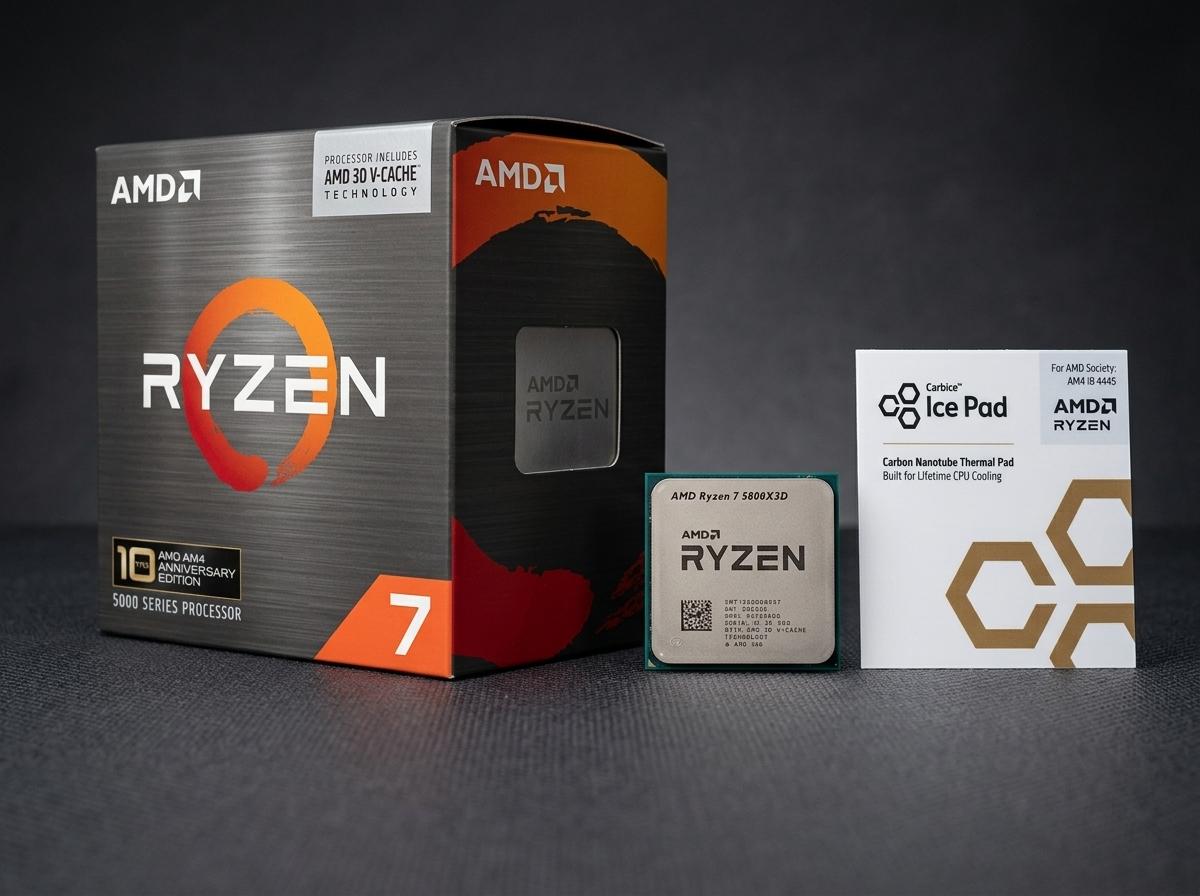
AMD Ryzen 7 5800X3D (10th Anniversary Edition)
The AMD Ryzen 7 5800X3D pairs 8 Zen 3 cores with 96 MB of 3D V-Cache, making it the fastest gaming CPU for socket AM4. It’s an ideal drop-in upgrade for existing AM4 owners, but new builders should weigh AM5 and its upgrade path.
Affiliate disclosure: GearNexis is a participant in the Amazon Services LLC Associates Program. As an Amazon Associate, we earn from qualifying purchases made through links on this page, at no extra cost to you. Commissions do not influence our ratings or recommendations.
How we researched this review: We did not test this processor ourselves. This review is based on AMD's and Intel's published specifications, independent reviews of the Ryzen 7 5800X3D 10th Anniversary Edition (mainly TechPowerUp, with TechSpot as a cross-check), and our own analysis of platform costs and upgrade paths. Benchmark figures are credited to their source and reflect that source's test setup.
Four years after it launched, the AMD Ryzen 7 5800X3D is back. In 2026, AMD re-released it as the Ryzen 7 5800X3D 10th Anniversary Edition (boxed part number 100-100000651POF). According to independent reviewers, the silicon is unchanged from the 2022 chip that brought AMD 3D V-Cache to desktop PCs. The differences are new packaging, a bundled Carbice thermal pad, and a much lower launch price than the original's $449 MSRP. This AMD Ryzen 7 5800X3D review explains who should still buy it, how it compares with newer Ryzen and Intel chips, and when your money is better spent elsewhere.
Quick Verdict
If you already own an AM4 motherboard, the Ryzen 7 5800X3D is still one of the most sensible gaming upgrades available. It drops into many 300-, 400- and 500-series boards, keeps your DDR4 memory, and TechPowerUp's 2026 testing puts its 1080p gaming performance roughly level with modern mid-range chips such as the Ryzen 5 9600X. It is not the fastest gaming CPU anymore: the Ryzen 7 7800X3D and Ryzen 7 9800X3D are clearly faster. Its multithreaded productivity performance is also modest, and AM4 has no further CPU upgrade path. Buy it to extend the life of an existing AM4 gaming PC. For a brand-new build with a long-term upgrade path, look at AM5 first.
Ryzen 7 5800X3D Key Specifications
| Specification | Ryzen 7 5800X3D |
|---|---|
| Architecture | Zen 3 ("Vermeer"), 7 nm CCD with stacked 3D V-Cache |
| Cores / Threads | 8 / 16 |
| Base / Max Boost Clock | 3.4 GHz / up to 4.5 GHz |
| L1 / L2 / L3 Cache | 512 KB / 4 MB / 96 MB |
| Default TDP | 105 W |
| Max Operating Temperature | 90 °C |
| Socket | AM4 |
| Memory | DDR4, dual channel (official support up to DDR4-3200, depending on DIMM configuration) |
| PCI Express | PCIe 4.0 (on supported motherboards) |
| Integrated Graphics | None; a discrete graphics card is required |
| Overclocking | Multiplier locked; Curve Optimizer undervolting available on modern BIOS versions |
| In the box (10th Anniversary Edition) | Processor and Carbice Ice Pad thermal pad; no CPU cooler |
| Original launch | April 2022 (10th Anniversary Edition re-release: 2026) |
About the "100 MB cache" figure: some retail listings advertise 100 MB of cache. That number adds the 4 MB of L2 to the 96 MB of L3. AMD's L3 figure is 96 MB: 32 MB on the CPU die plus a 64 MB stacked V-Cache die.
What Is AMD 3D V-Cache, and Why Does It Matter for Gaming?
A CPU's L3 cache is a small pool of very fast memory that sits on the processor. When the data a core needs is already in cache, it skips the much slower trip to system RAM. Games constantly reuse data such as world state, AI and physics information, and draw-call bookkeeping, so many games benefit from a large cache.
The 5800X3D is built on the same 8-core Zen 3 die as the Ryzen 7 5800X, with an extra 64 MB slice of cache stacked on top. That triples the L3 cache from 32 MB to 96 MB. In cache-sensitive games, the extra cache more than makes up for lower clock speeds.
The design has trade-offs. Because the cache die sits on top of the cores in this first-generation design, AMD limits voltage and temperature. The chip has a 90 °C thermal limit, a 4.5 GHz boost ceiling, and a locked multiplier. AMD's later Zen 5 X3D parts, such as the 9800X3D, move the cache underneath the cores and allow overclocking again.
Ryzen 7 5800X3D Gaming Performance
Gaming is the reason this processor exists. TechPowerUp's 2026 review of the 10th Anniversary Edition used a GeForce RTX 5090 and DDR4-3600 memory on AM4. In its average across all tested games at 1920×1080, it reported these relative results, with the 5800X3D at 100%:
- Ryzen 7 9800X3D: about 121%
- Ryzen 7 7800X3D: about 111%
- Core i7-14700K: about 103%
- Ryzen 5 9600X: about 100%
- Ryzen 7 5800X: about 83%
At 3840×2160, the gaps shrink because the graphics card becomes the main limit: the 9800X3D leads by about 10%, the 7800X3D by about 5.5%, and the 5800X trails by about 9%. Treat these as the averages of one outlet's test suite, not universal numbers. Individual games vary a lot. TechPowerUp notes that some modern engines leave the 5800X3D well behind newer CPUs, because when a game's working set no longer fits in cache, single-thread speed and DDR5 bandwidth start to matter. TechSpot's review reached a similar overall conclusion and placed the chip around Ryzen 5 9600X territory.
How resolution, GPU, and test setup change the picture
- 1080p with a fast GPU is where CPU differences are most visible. Competitive and high-refresh-rate players benefit most from a faster CPU here.
- 1440p and 4K shift more of the load to the graphics card, so many games show smaller CPU gaps. If you game at 4K with a mid-range GPU, a CPU upgrade alone may change little.
- Memory speed and timings affect AM4 results. Reviewers commonly use DDR4-3600 at a 1:1 Infinity Fabric ratio as the sweet spot. Slower or poorly configured RAM narrows the 5800X3D's advantage.
- Game choice matters. Simulation, strategy, and some MMO and esports titles tend to love extra cache. Other games scale more with clock speed and architecture.
Productivity and Multitasking Performance
This is the 5800X3D's weak spot. Eight Zen 3 cores at 3.4–4.5 GHz fall well behind current 8-core and hybrid processors in rendering, compression, encoding, and other heavily multithreaded work. Its single-thread speed is also below modern chips, and it lacks AVX-512. For everyday use (web browsing, office apps, streaming video, chat apps, and light content creation), 8 cores and 16 threads are still enough. If you regularly render video, compile large codebases, or run heavy multithreaded workloads, a newer chip such as the Intel Core i5-14600K or an AM5 Ryzen will serve you better.
Cooling, Power Consumption, and Thermals
The 5800X3D has a 105 W default TDP. TechPowerUp measured it well under 100 W even in heavy multithreaded tests and far lower in games, and found it much more efficient than the non-X3D 5800X. No cooler comes in the box. A competent single-tower air cooler is generally enough, and a larger cooler mainly buys lower noise. The 90 °C limit is a design ceiling for the stacked cache, not a sign that the chip runs hot under good cooling.
The 10th Anniversary Edition includes a Carbice Ice Pad, a carbon-nanotube thermal pad, in place of thermal paste. TechPowerUp found the pad needed several heat cycles to "burn in." After that it ran a few degrees warmer than good paste, but it does not pump out over time. You can use the pad or apply your preferred paste. Modern BIOS versions also allow Curve Optimizer undervolting (capped at ±30), which mainly lowers power, temperature, and noise rather than raising frame rates.
Motherboard, BIOS, RAM, and AM4 Compatibility
- Socket: AM4. The chip is listed for X570, B550, A520, X470 and B450 chipsets, and many X370, B350 and A320 boards gained support through later BIOS releases.
- BIOS: Support depends on your exact motherboard model and BIOS version. Before buying, check your board maker's CPU support list. If your board needs a BIOS update, install it before swapping CPUs, either with your current CPU or with BIOS Flashback if your board has it.
- Memory: DDR4 only. AMD's official rating is up to DDR4-3200 in two-DIMM setups, and lower with four DIMMs. Many reviewers run DDR4-3600 (an overclock over AMD's official rating) for the best gaming results.
- Graphics: No integrated graphics, so you need a discrete GPU. Keep that in mind for troubleshooting too.
GPU Pairing and PCIe Considerations
The 5800X3D supports PCIe 4.0 on boards that offer it (generally X570 and B550 for the main graphics slot; older chipsets run PCIe 3.0). TechPowerUp ran its gaming tests over PCIe 4.0 with an RTX 5090 and saw no evidence that the lack of PCIe 5.0 held the CPU back. The 5800X3D is a sensible match for mid-range to upper-high-end GPUs, especially for 1080p and 1440p high-refresh gaming. With an entry-level GPU, you are likely GPU-limited and a cheaper CPU may perform almost the same. On a B450 or X470 board, the main graphics slot runs at PCIe 3.0. That usually costs little with x16 cards, but cards with only 8 PCIe lanes can lose more performance on PCIe 3.0.
Pros and Cons
Pros
- Strong gaming performance from 96 MB of L3 cache. The fastest gaming CPU for socket AM4 in TechPowerUp's testing.
- Drop-in upgrade for many existing AM4 boards, reusing your DDR4 memory.
- Low power draw and easy to cool.
- 10th Anniversary Edition includes a Carbice thermal pad and launched well below the original's MSRP.
- Simple 8-core design with no hybrid P-core/E-core scheduling.
Cons
- Clearly slower in games than the Ryzen 7 7800X3D and 9800X3D.
- Weak multithreaded productivity performance by 2026 standards.
- No overclocking; Curve Optimizer is capped.
- AM4 is a dead-end platform: DDR4 and PCIe 4.0 only, with no future CPU upgrades.
- No integrated graphics or bundled cooler.
- The bundled thermal pad needs burn-in time to reach its best temperatures.
Ryzen 7 5800X3D vs 5700X3D, 5800X, 7800X3D, 9800X3D and Core i5-14600K
| Processor | Cores / Threads | Platform | Performance and Use Case | Main Trade-Off | Amazon Link |
|---|---|---|---|---|---|
| AMD Ryzen 7 5800X3D | 8 / 16 | AM4, DDR4, PCIe 4.0 | Fastest AM4 gaming CPU; 3.4/4.5 GHz with 96 MB L3. Best for AM4 owners upgrading for games. | Older Zen 3 cores; weak multithreaded work; no upgrade path. | Check Price on Amazon |
| AMD Ryzen 7 5700X3D | 8 / 16 | AM4, DDR4, PCIe 4.0 | Same 96 MB L3 at lower 3.0/4.1 GHz clocks. Budget AM4 gaming upgrade. | Somewhat slower than the 5800X3D because of lower clocks; we found no comparable 2026 multi-game data. | Check Price on Amazon |
| AMD Ryzen 7 5800X | 8 / 16 | AM4, DDR4, PCIe 4.0 | Unlocked Zen 3 with 32 MB L3. About 17% slower than the 5800X3D at 1080p in TechPowerUp's 2026 average. | Much less cache; less efficient; worse gaming value if X3D pricing is close. | Check Price on Amazon |
| AMD Ryzen 7 7800X3D | 8 / 16 | AM5, DDR5, PCIe 5.0-capable | Zen 4 X3D; about 11% faster than the 5800X3D at 1080p (TechPowerUp). For new gaming builds. | Needs a new AM5 motherboard and DDR5 memory. | Check Price on Amazon |
| AMD Ryzen 7 9800X3D | 8 / 16 | AM5, DDR5, PCIe 5.0-capable | Zen 5 X3D with cache under the cores; about 21% faster at 1080p (TechPowerUp). For high-end gaming. | Highest total platform cost; DDR5 required. | Check Price on Amazon |
| Intel Core i5-14600K | 14 (6P + 8E) / 20 | LGA1700, DDR4 or DDR5 | Up to 5.3 GHz with integrated UHD 770 graphics. Much stronger multithreaded performance. For mixed gaming and productivity. | Higher power (181 W max turbo); dead-end socket; not in TechPowerUp's 2026 5800X3D test group. | Check Price on Amazon |
Performance percentages are TechPowerUp's 1080p averages from its 2026 test suite (RTX 5090). Prices change often, so check current listings before you decide.
Ryzen 7 5800X3D vs 5700X3D
Both chips have 8 cores and 96 MB of L3 cache and work on the same AM4 boards. The Ryzen 7 5700X3D runs 400 MHz lower on both base and boost clocks, so it is usually a little slower in CPU-limited games. We could not find a 2026 multi-game test from a major outlet that compared both chips directly, so we won't quote a percentage. If the 5700X3D is meaningfully cheaper where you shop, it is the value pick. If prices are close, the 5800X3D is the faster AM4 chip.
Ryzen 7 5800X3D vs 5800X
The two chips have the same core count and the same Zen 3 cores. The Ryzen 7 5800X clocks higher (up to 4.7 GHz) and is unlocked, which helps slightly in some productivity tasks. For gaming, the X3D's extra cache matters more: TechPowerUp measured the 5800X roughly 17% behind at 1080p and about 9% behind at 4K. If you already own a 5800X or 5700X, TechPowerUp suggests the upgrade is less compelling given AM4's lack of a future.
Ryzen 7 5800X3D vs 7800X3D and 9800X3D
The Ryzen 7 7800X3D and Ryzen 7 9800X3D have the same 96 MB L3 capacity, but newer cores, much higher clocks, and DDR5 bandwidth. Both are clearly faster in games. The catch is platform cost: both need an AM5 motherboard and DDR5. At the time of TechPowerUp's review, DDR5 prices had risen sharply. If you are starting from scratch and can afford it, AM5 is the better long-term investment because it keeps a CPU upgrade path open. If you already own a capable AM4 system, the 5800X3D captures much of the gaming benefit for the cost of a CPU alone.
Ryzen 7 5800X3D vs Intel Core i5-14600K
The Core i5-14600K is a 14-core hybrid chip (6 performance and 8 efficiency cores) with integrated graphics. It supports both DDR4 and DDR5 on LGA1700 boards. It is much stronger in multithreaded work and has a working iGPU, but its maximum turbo power is 181 W, so it needs more cooling. LGA1700 also has no further upgrades. TechPowerUp's 2026 5800X3D review did not include the 14600K, so we cannot give a reliable like-for-like gaming percentage. If you choose Intel 13th/14th-gen, install the latest motherboard BIOS with Intel's updated microcode. Pick the 14600K if you need a balanced gaming and productivity build, especially one that can reuse DDR4.
Value for Money
At its launch price, the 10th Anniversary Edition is a lot of money for a 2022 design. Its value depends almost entirely on what you already own. For an existing AM4 system, the cost is the CPU alone: no new motherboard, no new memory, and often the same cooler. In TechPowerUp's analysis, that is what made the chip worth considering in 2026, when DDR5 memory had become very expensive. For a brand-new build, add the cost of an AM4 board and DDR4. Then compare it honestly with an AM5 build that can take future CPUs. Prices for CPUs, boards, and memory change frequently, so compare current listings before you buy.
Advice for Existing AM4 Owners
- Coming from Ryzen 1000, 2000 or 3000, or a 6-core Ryzen 5: this is the upgrade the 5800X3D was made for. Expect a large gaming improvement, especially at 1080p and 1440p with a capable GPU.
- Coming from a Ryzen 7 5700X or 5800X: the gain is real but smaller. Consider whether to keep your money for a future AM5 move instead.
- Before you buy: confirm your board is on the manufacturer's CPU support list, update the BIOS first, and check that your cooler mounts on AM4. Most existing AM4 coolers are compatible.
Advice for New PC Builders
A new AM4 build is a dead end: this is the last class of CPU those boards will ever run. It can still make sense for a tight budget, particularly with used B550 boards and DDR4 kits, if you are happy to replace the whole platform later. If you want a CPU upgrade path, choose AM5 with a Ryzen 7 7800X3D or 9800X3D, or a more affordable AM5 chip. If you also need strong multithreaded performance on a budget, consider Intel's Core i5-14600K.
Who Should Buy the Ryzen 7 5800X3D?
- AM4 owners who want the biggest gaming upgrade without replacing their motherboard and RAM.
- Gamers playing at 1080p or 1440p with a mid-range to high-end GPU.
- Players of cache-sensitive simulation, strategy, and high-refresh-rate games.
- Builders who want an efficient, easy-to-cool gaming chip for a quieter or smaller AM4 PC.
Who Should Consider Alternatives?
- New builders who want a CPU upgrade path: choose AM5 with a Ryzen 7 7800X3D or Ryzen 7 9800X3D.
- Budget-focused AM4 gamers: compare prices on the Ryzen 7 5700X3D.
- Creators and heavy multitaskers: a modern multi-core chip such as the Intel Core i5-14600K or a newer Ryzen will finish multithreaded jobs faster.
- Anyone who needs integrated graphics: the 5800X3D has none.
- 4K gamers with a mid-range GPU: your GPU is likely the limit, so a GPU upgrade may help more.
Frequently Asked Questions
Is the Ryzen 7 5800X3D still worth buying in 2026?
Yes, if you already have an AM4 motherboard and mainly game. It is the fastest gaming CPU for AM4 and avoids buying a new board and memory. For a new build, AM5 offers more performance and an upgrade path.
What is the 10th Anniversary Edition?
It is AMD's 2026 re-release of the Ryzen 7 5800X3D (part number 100-100000651POF). Independent reviewers report the silicon and specifications are the same as the 2022 original. The box adds a Carbice Ice Pad thermal pad.
Is the Ryzen 7 5800X3D good for gaming?
Yes. In TechPowerUp's 2026 testing, its 1080p gaming average was roughly level with the Ryzen 5 9600X and about 17% ahead of the Ryzen 7 5800X. It trails the Ryzen 7 7800X3D and 9800X3D.
Ryzen 7 5800X3D vs 5700X3D: which should I buy?
They share the same 96 MB L3 cache, but the 5800X3D runs 400 MHz higher. Buy the 5800X3D for the most AM4 gaming performance, or the 5700X3D if it is meaningfully cheaper.
Which motherboards support the Ryzen 7 5800X3D?
AM4 boards using X570, B550, A520, X470 and B450 chipsets, plus many X370, B350 and A320 boards with updated BIOS. Always check your board maker's CPU support list for the exact model.
Do I need a BIOS update?
Often, yes, especially on older boards. Update the BIOS to a version listed as supporting the 5800X3D before installing the chip.
Does the Ryzen 7 5800X3D include a cooler or integrated graphics?
No. It has no bundled cooler and no integrated graphics, so you need an aftermarket cooler and a discrete graphics card. The 10th Anniversary Edition does include a thermal pad.
Can you overclock the Ryzen 7 5800X3D?
Not in the traditional sense, because the multiplier is locked. Modern BIOS versions allow Curve Optimizer undervolting, which mainly reduces power and temperatures.
Is the Ryzen 7 5800X3D good for productivity?
It handles everyday work well, but it falls behind modern CPUs in heavily multithreaded tasks such as rendering and encoding.
Final Verdict: Should You Buy the AMD Ryzen 7 5800X3D?
The Ryzen 7 5800X3D is no longer a performance leader, and this review does not pretend otherwise. It is, however, still the best way to turn an existing AM4 PC into a strong gaming machine with nothing more than a CPU swap and a BIOS update. If that describes your PC, it earns a clear recommendation. If you are building from scratch or need serious multithreaded performance, the alternatives above are the better investment.
Pros
- Excellent gaming performance from 96 MB of L3 3D V-Cache
- Fastest gaming CPU available for socket AM4 in independent testing
- Drop-in upgrade for many existing AM4 motherboards; reuses DDR4 memory
- Low power draw and easy to cool
- 10th Anniversary Edition bundles a Carbice thermal pad and launched well below the original MSRP
- Simple 8-core design with no hybrid core scheduling
Cons
- Clearly slower in games than the Ryzen 7 7800X3D and 9800X3D
- Weak multithreaded productivity performance by current standards
- Multiplier locked; Curve Optimizer is capped at ±30
- AM4 is a dead-end platform limited to DDR4 and PCIe 4.0
- No integrated graphics and no bundled cooler
- Bundled thermal pad needs burn-in time to reach its best temperatures
Spec Sheet
Specifications
General
| Brand | AMD |
|---|---|
| Model | Ryzen 7 5800X3D |
| Edition | 10th Anniversary Edition (boxed part 100-100000651POF) — confirm on live listing |
| Architecture | Zen 3 |
| Original Launch Date | April 20, 2022 |
Performance
| Cores | 8 |
|---|---|
| Threads | 16 |
| Base Clock | 3.4 GHz |
| Max Boost Clock | Up to 4.5 GHz |
| Unlocked for Overclocking | No (Curve Optimizer undervolting supported on modern BIOS) |
Cache
| L1 Cache | 512 KB |
|---|---|
| L2 Cache | 4 MB |
| L3 Cache | 96 MB |
Power
| Default TDP | 105 W |
|---|---|
| Max Operating Temperature (Tjmax) | 90 °C |
Compatibility
| Socket | AM4 |
|---|---|
| PCI Express Version | PCIe 4.0 (on supported motherboards) |
Memory
| Memory Type | DDR4 |
|---|---|
| Memory Channels | 2 |
| Official Memory Speed | Up to DDR4-3200 (2-DIMM configurations; lower with 4 DIMMs — verify on AMD spec page) |
Graphics
| Integrated Graphics | Discrete graphics card required |
|---|
Cooling
| Included Cooler | No thermal solution included (10th Anniversary Edition includes a Carbice Ice Pad thermal pad) |
|---|
Frequently Asked Questions
Is the Ryzen 7 5800X3D still worth buying in 2026?+
What is the Ryzen 7 5800X3D 10th Anniversary Edition?+
Is the Ryzen 7 5800X3D good for gaming?+
Ryzen 7 5800X3D vs 5700X3D: which should I buy?+
Which motherboards support the Ryzen 7 5800X3D?+
Do I need a BIOS update for the 5800X3D?+
Does the Ryzen 7 5800X3D include a cooler or integrated graphics?+
Can you overclock the Ryzen 7 5800X3D?+
Is the Ryzen 7 5800X3D good for productivity?+
As an Amazon Associate we earn from qualifying purchases. See our affiliate disclosure.